


The Role of Computer Vision in Business Innovation: What Every Business Owner Needs to Know
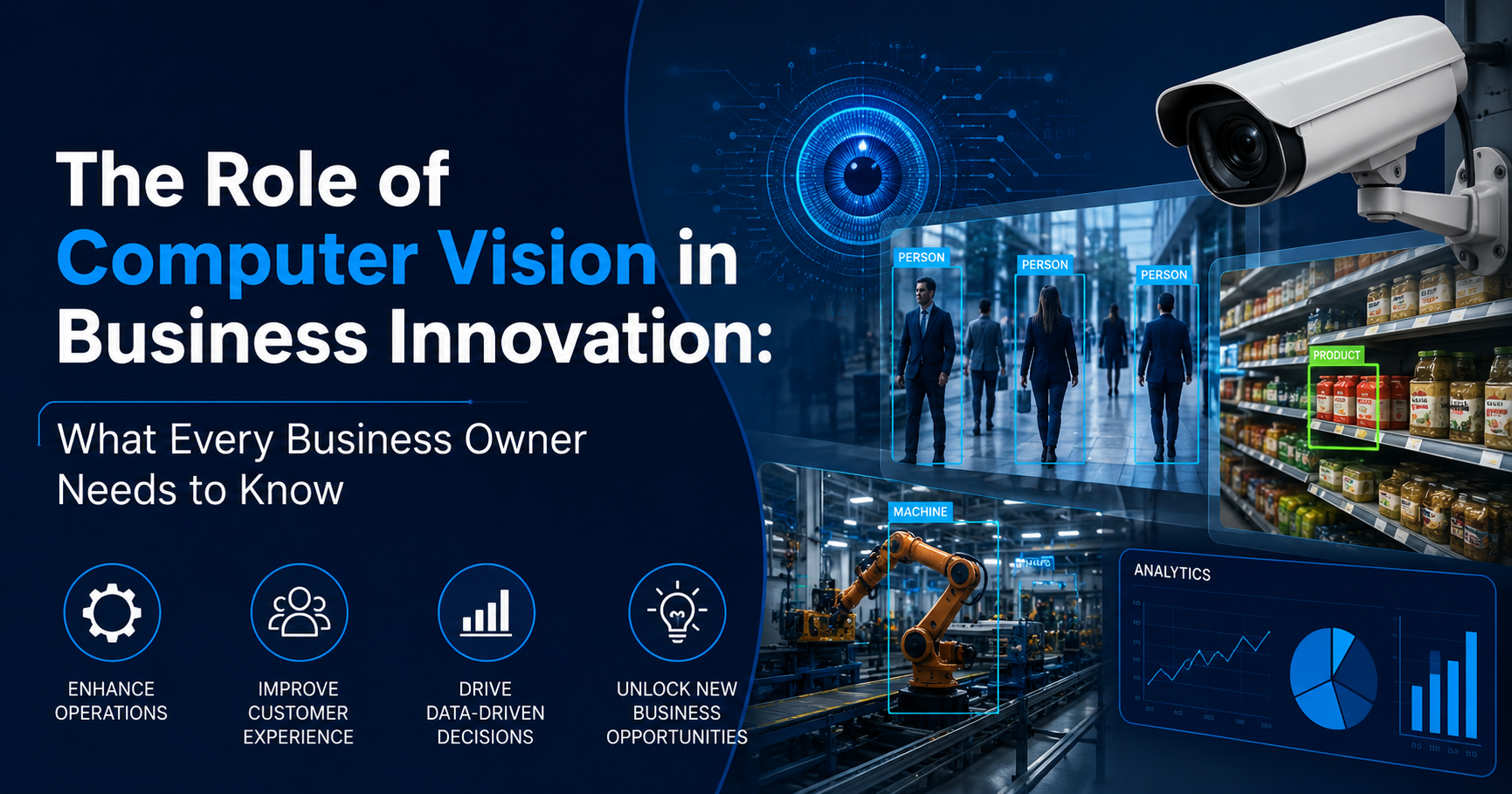
There's a quiet revolution unfolding across industries — and it doesn't announce itself with fanfare. It shows up in the warehouse that ships 40% faster. It appears in the retail store that spots shoplifting before it happens. It lives inside the factory floor that hasn't had a defective product reach a customer in months. That revolution has a name: computer vision.
For business owners, the conversation around artificial intelligence has often felt abstract — something happening in research labs or Silicon Valley boardrooms. But computer vision is different. It's tangible, measurable, and already delivering returns for businesses of every size. At its core, computer vision is the technology that enables machines to interpret and act on visual data — images, video, real-time camera feeds — the same way humans use their eyes to make decisions. The difference is that machines can do it faster, around the clock, without fatigue, and at a scale no human team could match. If you're running a business and haven't seriously evaluated how computer vision fits your operations, this article is your starting point.
What Computer Vision Actually Does for Your Business
Before diving into applications, let's get clear on the mechanism. Computer vision systems are trained on vast amounts of visual data using deep learning and neural networks. Once trained, they can identify objects, detect anomalies, read text, recognize faces, measure dimensions, track movement, and make real-time decisions based on what they "see." This is not a prototype technology — it's production-grade, deployed at scale across logistics, healthcare, agriculture, retail, manufacturing, and financial services.
What makes this especially relevant for business owners today is accessibility. You no longer need an in-house research team or a Fortune 500 budget to implement computer vision. The ecosystem of computer vision development services has matured significantly, making it possible for mid-size and even small businesses to deploy customized vision-based solutions through experienced partners. The real question isn't whether computer vision is relevant to your industry — it almost certainly is. The question is where to start and who to work with.
Key Industries Being Transformed Right Now
Computer vision's impact isn't confined to a single vertical. Its applicability is remarkably broad, which is part of what makes it such a powerful lever for business innovation. Here's where it's creating the most significant shifts:
Retail and E-Commerce — Brick-and-mortar retailers are using computer vision for automated checkout, shelf monitoring, foot traffic analysis, and loss prevention. Online platforms use it for visual search, enabling customers to upload a photo and find matching products instantly. The customer experience improves, and operational overhead drops simultaneously.
Manufacturing and Quality Control — Traditional quality inspection relies on human inspectors who tire, miss defects, and create bottlenecks. Computer vision systems inspect thousands of units per minute with consistent accuracy, flagging defects at a granularity the human eye cannot reliably achieve.
Healthcare and Diagnostics — Medical imaging analysis using computer vision is accelerating diagnostic accuracy for radiology, pathology, and dermatology. This doesn't replace clinicians — it gives them sharper, faster tools.
Logistics and Warehousing — From package sorting and inventory management to autonomous vehicles navigating warehouse floors, computer vision is the backbone of modern logistics efficiency.
Agriculture — Drone-based crop monitoring, pest detection, and yield forecasting are giving farmers data they've never had access to before, directly affecting profitability.
Financial Services — Document verification, fraud detection through behavioral analysis, and KYC (Know Your Customer) processes are being streamlined through vision-based automation.
The throughline across all of these? Businesses that invest early in computer vision software development are establishing operational advantages that compound over time — and those who wait are increasingly playing catch-up.
The Business Case: Why Now, Not Later
If you're a business owner evaluating whether to invest in computer vision, the timing argument deserves serious attention. The cost of implementing computer vision has dropped substantially over the past five years. Cloud infrastructure, pre-trained models, and open-source frameworks have lowered the barrier to entry. Meanwhile, the competitive advantage for early adopters continues to grow.
Consider the numbers: according to industry reports, computer vision is projected to reach a market valuation exceeding $48 billion by 2030. Businesses across sectors are reporting ROI timelines of 12 to 24 months on targeted computer vision deployments — faster than most enterprise software implementations. Beyond ROI, there's the compounding effect: once a vision system is in place and trained on your business data, it gets smarter over time. The gap between businesses using these systems and those that aren't will continue to widen. Here's what the business case typically looks like in practice:
- Labor cost reduction through automation of repetitive visual tasks (inspection, counting, sorting, verification)
- Error rate reduction that directly impacts product quality, customer satisfaction, and warranty/return costs
- Speed improvements in processes that previously required human review, reducing cycle times across operations
- Real-time insights from physical environments that were previously invisible to management dashboards
- Risk mitigation through proactive detection of anomalies, safety violations, and fraud signals
- Scalability — vision systems handle increased volume without proportional increases in cost
The businesses seeing the strongest results aren't those deploying computer vision as a novelty. They're the ones identifying a specific operational pain point — a quality control bottleneck, a manual inspection process, a fraud exposure — and solving it with precision-built computer vision software development tailored to their environment.
Choosing the Right Development Partner
Here's where many business owners stumble. The technology itself is only part of the equation. Implementing computer vision in a way that delivers business value requires deep expertise in machine learning, data engineering, domain-specific training, and integration with existing systems. A generic software firm cannot do what a specialized computer vision development company can — and that difference shows up in outcomes.
When evaluating partners, the distinction matters enormously. A true specialist brings pre-existing datasets, domain knowledge relevant to your industry, and experience with the real-world messiness of deploying vision systems in production environments — variable lighting, camera angles, edge cases, latency constraints. They've solved these problems before. A generalist firm is solving them for the first time on your budget and timeline. The criteria that matter most when selecting a computer vision software development company:
- Domain experience — Have they built solutions specifically for your industry? The nuances of retail shelf monitoring are fundamentally different from the nuances of medical image analysis.
- End-to-end capability — Can they handle data collection, model training, deployment, integration, and ongoing maintenance, or will you be stitching together multiple vendors?
- Transparency in methodology — Do they explain how their models are trained, what accuracy benchmarks they target, and how they handle model drift over time?
- References and case studies — Real-world deployments with measurable outcomes are non-negotiable. Ask for them.
- Post-deployment support — Computer vision systems require monitoring, retraining, and iteration. The relationship doesn't end at launch.
- Scalability architecture — Can the solution grow with your business without a full rebuild?
Working with skilled computer vision developers who have production experience isn't just a quality preference — it's a risk management decision. Poorly implemented vision systems create technical debt, miss edge cases that cause failures at scale, and ultimately undermine trust in the technology within your organization.
Building an AI-Ready Business: Where Computer Vision Fits Your Strategy
Computer vision doesn't exist in isolation. It's most powerful when it's connected to your broader data infrastructure — your ERP systems, your customer platforms, your supply chain tools. This integration layer is where business owners need to think strategically, not just tactically. The question isn't "can computer vision do X?" It's "how does computer vision feed better data into our decision-making systems?"
The businesses extracting the most value from computer vision are those that have thought through the data flow: the vision system captures and processes visual data, that data is structured and stored, it feeds into analytics dashboards or triggers automated workflows, and human decision-makers act on better information faster. This loop — capture, process, integrate, act — is where business innovation actually happens. It's also where working with experienced computer vision development services providers pays dividends, because designing that loop correctly from the start saves enormous rework downstream. Strategic integration considerations include:
- API and middleware design to connect vision outputs with existing business systems
- Data governance protocols for visual data, especially where privacy regulations apply (facial recognition, biometric data)
- Model monitoring infrastructure to detect accuracy degradation and trigger retraining
- Change management — your teams need to understand and trust the systems they're working alongside
- Pilot-to-scale planning — starting with a contained use case and building a roadmap for broader deployment
- KPI definition — establishing clear success metrics before deployment so you can measure actual business impact
Emerging Frontiers: What's Coming Next
For business owners thinking beyond the current horizon, the next wave of computer vision capabilities is already visible. Edge computing is enabling vision processing directly on devices — cameras, sensors, embedded systems — without reliance on cloud connectivity, which opens applications in environments where latency or connectivity constraints previously made vision systems impractical.
Multimodal AI is combining computer vision with natural language processing and other data types, creating systems that don't just see, but reason across multiple inputs simultaneously. Generative AI intersecting with computer vision is opening new possibilities in product design, synthetic training data generation, and simulation. For business owners, these aren't distant science fiction scenarios — they're capabilities that forward-looking computer vision developers are already prototyping and deploying for early-adopter clients. The businesses building relationships with strong development partners today are positioning themselves to access these capabilities as they mature, rather than playing catch-up when they become standard.
Final Word: The Cost of Waiting
Computer vision is one of those technologies where the cost of inaction is real and measurable. Every quarter a competitor automates a process you're still running manually is a quarter of efficiency gap that compounds. Every defect that reaches your customer because your inspection process relies on human eyes is a warranty cost, a reputation cost, and a data point your competitors using vision-based QA aren't generating.
The good news is that the ecosystem of computer vision software development expertise has never been more accessible. Finding a specialist computer vision development company with the domain knowledge, technical depth, and track record to deliver production-grade solutions is a realistic option for businesses at almost every scale today. The conversation starts with identifying your highest-leverage problem — the bottleneck, the risk, the cost center — and asking whether visual data is part of the equation. In most businesses, the answer is yes. What happens next is up to you.

 English
 Arabic
 French
 Spanish
 Deutsch
 Turkish
 Dutch
Dutch
 Italiano
 Russian
 Romaian
 Portuguese (Brazil)
 Greek
Greek