


What Is Driving Global Biodiesel Market Growth Through 2034?
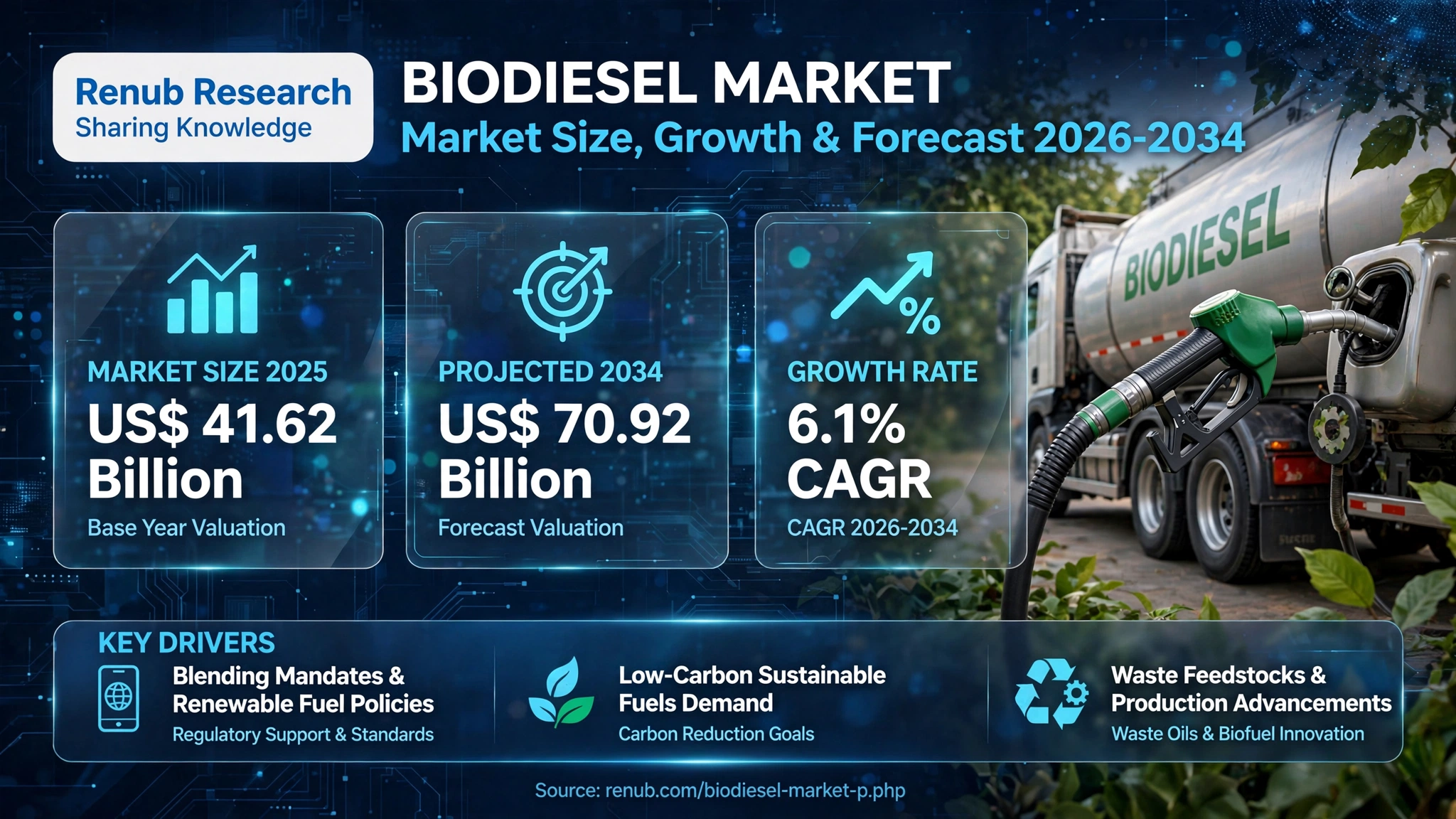
The global biodiesel market is entering a period of sustained expansion as governments, transportation operators, industries, and consumers increasingly prioritize renewable and lower-carbon energy solutions. According to Renub Research, the global biodiesel market is projected to grow from US$41.62 billion in 2025 to US$70.92 billion by 2034, registering a CAGR of 6.1% from 2026 to 2034. Growth is being supported by renewable fuel mandates, greenhouse gas reduction targets, rising investment in biofuel infrastructure, and growing use of vegetable oils, animal fats, and used cooking oil as feedstocks.
Biodiesel is particularly attractive because it can be blended with conventional diesel and used in many existing diesel engines without major modifications. Its established compatibility with transportation, agriculture, industrial equipment, and power generation gives the fuel an important role in the transition toward cleaner energy.
What Is Biodiesel and Why Is It Becoming More Popular?
Biodiesel is a renewable and biodegradable fuel manufactured from biological feedstocks such as vegetable oils, animal fats, used cooking oil, and other organic sources. Through transesterification, natural oils and fats are converted into fuel suitable for diesel engines. Biodiesel can be used in different blends, including B5, B10, B20, and B100, depending on application, regulations, and fuel specifications.
Its popularity is closely linked to concerns about climate change, air pollution, fossil-fuel dependence, and energy security. Biodiesel is used in passenger vehicles, commercial trucks, buses, agricultural machinery, marine applications, construction equipment, and power generation. The source also highlights lower emissions of carbon monoxide, particulate matter, hydrocarbons, and sulfur compounds compared with conventional fossil diesel.
More than 70 countries have introduced biodiesel blending mandates or renewable fuel policies, helping create a broad international demand base.
How Large Is the Global Biodiesel Market?
Renub Research estimates that the global biodiesel market will increase from US$41.62 billion in 2025 to US$70.92 billion by 2034, representing a 6.1% CAGR during 2026–2034.
This expansion reflects the combination of policy support, growing renewable fuel consumption, increased production capacity, and feedstock diversification. Biodiesel is no longer limited to conventional vegetable-oil production. Waste cooking oil, animal fats, non-edible oils, and other alternative feedstocks are becoming increasingly important.
The market also benefits from its ability to serve multiple sectors. Transportation remains the principal application, while power generation and other industrial uses provide additional opportunities.
What Is Driving Biodiesel Market Growth?
Government Blending Mandates and Renewable Fuel Policies
Government policy is one of the strongest forces supporting biodiesel demand. More than 70 countries have implemented blending mandates or renewable fuel standards. Regulations and incentives encourage fuel suppliers and producers to incorporate renewable fuels into conventional transportation systems.
Programs and policies in the European Union, United States, Brazil, Indonesia, and India are helping create long-term demand. Blending requirements such as B5, B10, B20, and Indonesia's B35 program provide producers with more predictable markets.
Government support can also include tax incentives, production assistance, infrastructure investment, and programs supporting waste-feedstock collection. As national climate targets become more ambitious, renewable fuel policies are expected to remain a central growth mechanism.
Rising Demand for Low-Carbon Transportation Fuels
Transportation is under increasing pressure to reduce emissions. Fleet operators, logistics companies, public transport systems, agricultural businesses, and industrial users are therefore examining renewable alternatives to conventional diesel.
Biodiesel offers an attractive transitional solution because it can work within existing diesel infrastructure and engine systems. Depending on the feedstock, biodiesel can provide substantial lifecycle greenhouse gas reductions compared with petroleum diesel.
Demand is especially relevant for applications where complete electrification may be difficult or expensive. Heavy-duty transport, agriculture, construction, marine operations, and other diesel-dependent activities can create continuing opportunities for renewable liquid fuels.
Growth of Waste-Based Feedstocks and Production Technology
The biodiesel industry is increasingly looking beyond food-grade vegetable oils. Used cooking oil, animal fats, and non-edible vegetable oils can provide alternative sources of raw material while supporting waste reduction and circular-economy objectives.
Improved processing technologies are also increasing feedstock flexibility and production efficiency. Better pretreatment methods, catalysts, collection systems, and refinery technologies can improve the commercial viability of challenging feedstocks.
The development of advanced biofuel technologies may further expand the market by allowing producers to utilize agricultural residues, algae, and other alternative resources.
What Challenges Could Limit Biodiesel Market Expansion?
Feedstock Price Volatility and Availability
Feedstock is one of the most important cost factors in biodiesel production. Vegetable oils, used cooking oil, and animal fats can experience significant price changes because of agricultural yields, weather, food demand, export restrictions, and geopolitical conditions.
Competition between food, feed, and fuel markets can create additional pressure. When vegetable-oil prices rise, biodiesel producers may face higher manufacturing costs and reduced margins.
Used cooking oil provides an attractive alternative, but collection infrastructure remains uneven across many markets. Better waste-oil collection, storage, transportation, and processing networks will therefore be essential for increasing the contribution of waste-derived biodiesel.
Competition From Electric Vehicles and Other Low-Carbon Fuels
Biodiesel is also facing increasing competition from electric vehicles, hydrogen, renewable diesel, and other low-carbon technologies. Electrification is particularly relevant to passenger vehicles and some urban transportation applications.
Renewable diesel is another important competitor because it can offer similar decarbonization benefits while providing strong compatibility with existing diesel infrastructure. Consequently, biodiesel producers will need to focus on efficient production, sustainable feedstocks, and applications where renewable liquid fuels offer clear operational advantages.
How Is Biodiesel Used in Transportation?
Biodiesel Fuel
Fuel is the largest application segment of the biodiesel market. Biodiesel is blended with conventional diesel at different concentrations and is used by commercial trucks, buses, agricultural machinery, mining equipment, municipal fleets, and other diesel-powered vehicles.
Its ability to integrate into existing transportation systems is a major advantage. Operators can adopt renewable fuel blends without necessarily replacing their entire vehicle fleets.
Developing economies may provide additional opportunities as transportation activity increases and governments seek to reduce petroleum dependence. Growing bio-refinery capacity and improved fuel standards could further support market expansion.
How Can Biodiesel Support Power Generation?
Biodiesel Power Generation
Biodiesel is also being adopted for backup and distributed power generation. It can be used in diesel generator sets serving commercial buildings, hospitals, telecommunications infrastructure, remote communities, agricultural operations, and industrial facilities.
The fuel can be particularly useful where electricity systems need dependable backup capacity. Biodiesel generators can complement intermittent renewable sources such as solar and wind, providing an additional energy option when renewable electricity production fluctuates.
Remote industrial and agricultural operations may also benefit from biodiesel because existing diesel-generation equipment can potentially be adapted to renewable fuel blends.
Which Feedstocks Are Dominating the Biodiesel Market?
Vegetable Oil
Vegetable oils remain the leading feedstock category because of established agricultural supply chains and effective conversion characteristics. Soybean, rapeseed, palm, sunflower, and canola oils are among the important feedstocks used around the world.
Feedstock selection varies by region according to agricultural availability. Soybean oil is particularly important in the Americas, rapeseed oil has a strong position in Europe, and palm oil is an important biodiesel feedstock in Southeast Asia.
Sustainably sourced vegetable oils are becoming increasingly important as producers and regulators pay greater attention to land use, environmental impacts, and supply-chain traceability.
Animal Fats
Animal fats are gaining attention as an alternative biodiesel feedstock. Tallow, poultry fat, lard, and other rendered materials can be converted into renewable fuel while supporting resource efficiency and waste reduction.
Animal-fat biodiesel can provide producers with another feedstock option, reducing reliance on edible vegetable oils. Advances in pretreatment and processing technologies are helping improve the conversion of high-free-fatty-acid feedstocks.
Which Countries Are Leading Biodiesel Market Development?
United States
The United States has one of the world's largest biodiesel markets, supported by renewable fuel policies, agricultural feedstocks, and established biofuel infrastructure. Soybean oil is a major feedstock, while used cooking oil, corn oil, and animal fats also contribute to production.
Demand comes from commercial transportation, agriculture, construction, public fleets, and other diesel-intensive sectors. Renewable fuel standards and state-level clean-fuel initiatives continue to support industry development.
United Kingdom
The United Kingdom is developing its biodiesel market through renewable transport policies and greater use of waste-derived feedstocks. Used cooking oil and animal fats are increasingly important because they can reduce reliance on food-based feedstocks.
Freight transport, commercial vehicles, agriculture, and public transportation represent important consumption areas. Investments in waste collection and advanced biofuel processing can further strengthen the market.
India
India presents substantial long-term potential as the government seeks to improve energy security, reduce crude-oil dependence, and expand renewable fuel use. The National Policy on Biofuels supports biodiesel production from non-edible oils, used cooking oil, animal fats, and agricultural waste.
Biodiesel opportunities extend across commercial transport, railways, agriculture, mining, and power generation. Improving used-cooking-oil collection and expanding bio-refinery investment could help strengthen domestic supply.
United Arab Emirates
The UAE biodiesel market is developing alongside broader sustainability and circular-economy initiatives. Waste cooking oil, waste vegetable oils, and animal fats provide potential feedstocks, particularly given the country's large hospitality, food-service, and tourism sectors.
Commercial fleets, municipal vehicles, industrial equipment, and backup power generation can create demand for biodiesel as organizations pursue lower-emission operations.
What Is the Future Outlook for Biodiesel?
The future of biodiesel will depend on how effectively the industry balances policy support, feedstock sustainability, technological progress, and competition from other low-carbon technologies.
Waste-based feedstocks are likely to remain an important area of development because they can reduce competition with food crops while supporting circular-economy objectives. Improved collection infrastructure could unlock additional volumes of used cooking oil in emerging markets.
Heavy-duty transportation, agriculture, marine applications, industrial equipment, and backup power generation may remain important because these sectors can be more difficult to electrify completely.
At the same time, biodiesel producers will need to manage feedstock costs and demonstrate environmental benefits through responsible sourcing and efficient production. The industry's ability to innovate will be critical as governments and businesses increasingly evaluate fuels according to lifecycle emissions rather than simply their renewable origin.
Biodiesel Market Segmentation
The global biodiesel market can be analyzed by application and feedstock. Application segments include fuel, power generation, and others, while feedstock segments include vegetable oil and animal fats.
The market covers major regions including North America, Europe, Asia Pacific, Latin America, and the Middle East & Africa. Key countries identified in the source include the United States, Canada, France, Germany, Italy, Spain, the United Kingdom, Belgium, the Netherlands, Turkey, China, Japan, India, Australia, South Korea, Thailand, Malaysia, Indonesia, New Zealand, Brazil, Mexico, Argentina, South Africa, Saudi Arabia, and the UAE.
Conclusion
The global biodiesel market is positioned for steady expansion as renewable fuel policies, sustainability objectives, and demand for lower-carbon transportation solutions reshape the energy landscape. Renub Research projects the market to rise from US$41.62 billion in 2025 to US$70.92 billion by 2034, reflecting a 6.1% CAGR from 2026 to 2034.
Government blending mandates remain a major growth catalyst, while waste feedstocks and technological improvements are broadening the industry's sustainability potential. Transportation is expected to remain the primary application, but power generation, agriculture, marine operations, and other diesel-dependent sectors can provide additional opportunities.
The market nevertheless faces feedstock price volatility and increasing competition from electric vehicles, renewable diesel, hydrogen, and other low-carbon technologies. Long-term growth will therefore depend on efficient production, sustainable feedstock sourcing, stronger collection systems, technological innovation, and strategic deployment in sectors where renewable liquid fuels can provide practical value.
FAQs
1. What is the global biodiesel market size in 2025?
The global biodiesel market is valued at US$41.62 billion in 2025, according to Renub Research.
2. What will the global biodiesel market be worth by 2034?
The market is projected to reach US$70.92 billion by 2034.
3. What is the expected biodiesel market CAGR from 2026 to 2034?
The global biodiesel market is projected to grow at a 6.1% CAGR from 2026 to 2034.
4. What are the main factors driving the biodiesel market?
Key growth factors include government blending mandates, renewable fuel policies, demand for low-carbon transportation fuels, investment in biofuel infrastructure, and increasing use of waste-based feedstocks.
5. What are the major biodiesel feedstocks?
The source identifies vegetable oil and animal fats as the major feedstock segments. Used cooking oil and other waste-based materials are also increasingly important in biodiesel production.
6. What are the major applications of biodiesel?
The primary applications are fuel and power generation, with additional uses grouped under other applications.
7. What challenges are affecting the biodiesel market?
The major challenges include feedstock price volatility, limited raw-material availability, collection infrastructure constraints, and competition from electric vehicles, renewable diesel, hydrogen, and other low-carbon technologies.

 Arabic
 French
 Spanish
 Portuguese
 Deutsch
 Turkish
 Dutch
 Italiano
 Russian
 Romaian
 Portuguese (Brazil)
 Greek