


Dementia vs. Alzheimer's Disease: What Is the Difference?
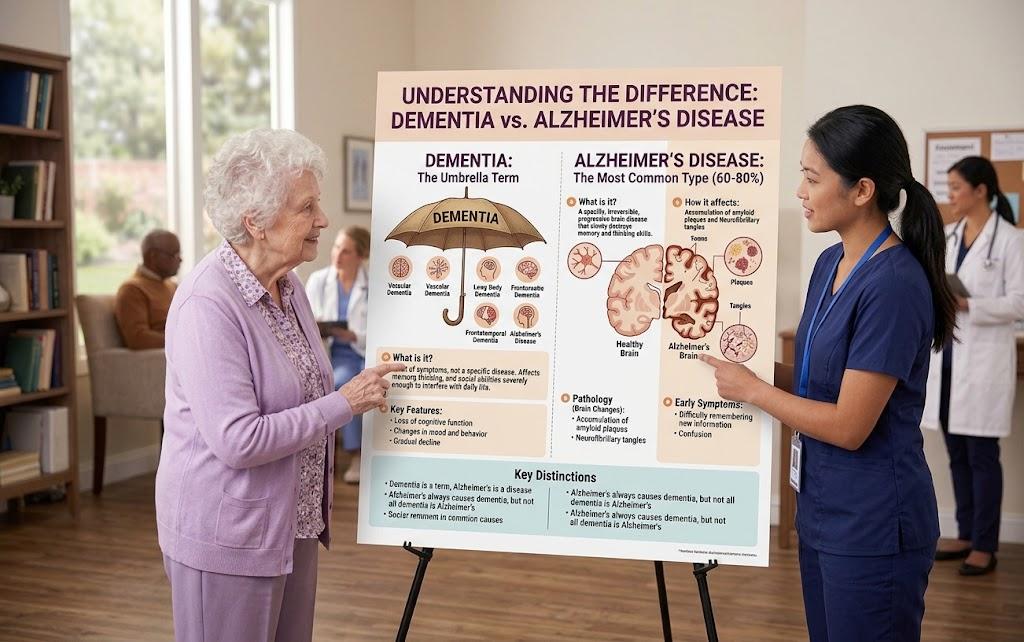
Dementia and Alzheimer’s disease are often used interchangeably, but they do not mean the same thing. Dementia describes a group of symptoms that affect memory, thinking, communication, and daily activities, while Alzheimer’s is a specific brain disease that commonly causes dementia. Understanding the difference can help families recognize symptoms and seek appropriate medical care.
What Is Dementia?
Dementia is an umbrella term for a decline in mental abilities that becomes severe enough to interfere with everyday life. It can affect memory, language, judgment, reasoning, attention, and problem-solving. Dementia is not one specific disease. Several different brain disorders and medical conditions can cause dementia or dementia-like symptoms.
A person with dementia may gradually lose the ability to manage finances, remember appointments, communicate clearly, prepare meals, or complete familiar tasks. The symptoms and rate of progression depend on the underlying cause.
What Is Alzheimer's Disease?
Alzheimer’s disease is a progressive neurological disorder that damages brain cells and affects memory, thinking, behavior, and eventually everyday functioning. It is the most common cause of dementia. The disease usually develops gradually, with symptoms becoming more noticeable as brain changes progress.
Alzheimer’s can begin with mild forgetfulness, such as repeatedly asking the same questions or forgetting recently learned information. Over time, symptoms can extend to communication, judgment, orientation, personality, and the ability to perform routine activities.
Dementia vs. Alzheimer's: The Main Difference
The simplest way to understand the difference is that dementia is a syndrome, while Alzheimer’s disease is a specific disease that can cause that syndrome. Dementia describes the problems a person experiences, whereas Alzheimer’s refers to one of the underlying causes of those problems.
For example, someone may have dementia caused by Alzheimer’s disease, vascular disease, Lewy body disease, or another condition. Therefore, not everyone with dementia has Alzheimer’s disease, although Alzheimer’s accounts for a large proportion of dementia cases.
Common Symptoms of Dementia
Dementia symptoms can vary significantly depending on the underlying condition. Memory loss is common, but dementia can also affect other areas of cognition and behavior. Some people experience changes in language or judgment first, while others primarily develop problems with memory and orientation.
Common symptoms may include:
- Forgetting important information
- Difficulty finding words
- Problems with planning and organization
- Confusion about time or place
- Difficulty performing familiar activities
- Changes in judgment
- Trouble recognizing familiar people
- Personality or mood changes
- Difficulty managing money or medications
- Reduced ability to live independently
The presence of one occasional symptom does not necessarily indicate dementia.
Common Symptoms of Alzheimer's Disease
Alzheimer’s disease often begins with changes in short-term memory. A person may forget recent conversations, appointments, or information they have just learned. As the condition progresses, additional cognitive and behavioral changes may appear and increasingly interfere with everyday activities.
Possible symptoms include:
- Increasing forgetfulness
- Repeating questions or statements
- Misplacing belongings
- Difficulty solving familiar problems
- Trouble completing routine tasks
- Difficulty finding the right words
- Confusion about dates and locations
- Changes in mood or personality
- Poor judgment
- Increasing dependence on caregivers
Symptoms usually develop gradually and become more noticeable over time.
Other Causes of Dementia
Alzheimer’s is only one possible cause of dementia. Different diseases affect different parts of the brain and can produce distinct combinations of symptoms. Some people may also have more than one underlying brain condition, which is sometimes referred to as mixed dementia.
Other causes include vascular dementia, Lewy body dementia, frontotemporal dementia, and dementia associated with Parkinson’s disease. Certain medical problems, medications, nutritional deficiencies, infections, or other conditions can also cause cognitive symptoms that may improve when the underlying problem is treated.
What Is Vascular Dementia?
Vascular dementia occurs when problems with blood flow to the brain damage brain tissue. It can develop after a major stroke or as a result of multiple smaller blood vessel injuries. The symptoms can include difficulties with planning, attention, reasoning, movement, and memory.
Risk factors for vascular dementia include high blood pressure, diabetes, high cholesterol, smoking, and other conditions affecting blood vessels. Managing cardiovascular risk factors is therefore an important part of protecting overall brain health.
What Is Lewy Body Dementia?
Lewy body dementia is another type of progressive dementia associated with abnormal deposits of a protein called alpha-synuclein in the brain. It can cause fluctuating attention, visual hallucinations, movement problems, sleep disturbances, and cognitive changes.
Unlike typical early Alzheimer’s disease, memory may not always be the first or most prominent problem. Symptoms can vary considerably from one day or time of day to another, making professional assessment particularly important.
What Is Frontotemporal Dementia?
Frontotemporal dementia affects areas of the brain involved in personality, behavior, language, and decision-making. It can cause significant changes in social behavior, emotional responses, communication, or personality. Memory may remain relatively preserved during the early stages compared with some other forms of dementia.
Frontotemporal dementia can occur at a younger age than many other types of dementia. Because early behavioral or language changes may be misunderstood, proper neurological assessment is important when these symptoms persist.
How Are Dementia and Alzheimer's Diagnosed?
There is no single test that can diagnose every form of dementia or confirm Alzheimer’s disease in every situation. Doctors usually review a person's medical history, symptoms, medications, and changes in daily functioning. Cognitive and neurological examinations may also be performed.
Depending on the situation, doctors may recommend blood tests, brain imaging, or other investigations to identify possible causes. Information from family members or caregivers can be particularly helpful because they may notice gradual changes that the person experiencing them does not recognize.
Can Dementia and Alzheimer's Be Treated?
Treatment depends on the underlying cause and the individual's symptoms. Some causes of cognitive impairment may be treatable, while progressive diseases such as Alzheimer’s require long-term management. Certain medications may help manage symptoms or slow progression in selected patients.
Non-medical approaches are also important. Regular physical activity, adequate sleep, social engagement, cognitive stimulation, a balanced diet, and management of conditions such as high blood pressure and diabetes can support overall health.
Caregiver education and a safe home environment become increasingly important as cognitive abilities decline.
When Should You See a Neurologist?
Persistent changes in memory, thinking, behavior, language, or daily functioning should be discussed with a healthcare professional. It is especially important to seek evaluation when symptoms are worsening or begin interfering with work, relationships, medication management, finances, driving, or personal care.
A neurologist can assess cognitive and neurological symptoms and help determine whether they may be related to Alzheimer’s disease, another form of dementia, or a potentially treatable condition.
Book Online Appointment With Best Neurologist via InstaCare
If you or someone in your family is experiencing persistent memory loss, confusion, communication difficulties, or noticeable changes in behavior, professional evaluation can help identify the possible cause. Book online appointment with the best neurologist via InstaCare to discuss concerning symptoms and explore appropriate evaluation and care options.
Conclusion
Dementia and Alzheimer’s disease are related but different terms. Dementia describes a group of symptoms involving cognitive decline that affects everyday life, while Alzheimer’s disease is a specific neurological condition and one of the leading causes of dementia.
Other conditions, including vascular dementia, Lewy body dementia, and frontotemporal dementia, can produce different patterns of cognitive and behavioral changes. Because early symptoms can overlap, a proper medical assessment is important for understanding the underlying cause. Early evaluation can also help families plan treatment, support, safety measures, and long-term care.
Frequently Asked Questions
1. Is Alzheimer's disease the same as dementia?
No. Dementia is a general term for a decline in cognitive abilities that interferes with daily life. Alzheimer’s disease is a specific neurological disease that is a common cause of dementia.
2. Can someone have dementia without having Alzheimer's?
Yes. Dementia can result from several conditions, including vascular dementia, Lewy body dementia, and frontotemporal dementia. Some people can also have more than one type of brain pathology.
3. Which usually starts first, memory loss or dementia?
Dementia is not a separate stage that necessarily follows memory loss. Memory loss can be an early symptom of some forms of dementia, particularly Alzheimer’s disease, but other types may initially cause changes in behavior, language, attention, or movement.
4. Can dementia be reversed?
Some causes of cognitive impairment may improve when the underlying problem is treated. However, many progressive neurodegenerative diseases that cause dementia cannot currently be completely reversed. The appropriate treatment depends on the underlying cause.
5. When should I see a neurologist for memory problems?
You should consider medical evaluation if memory or thinking problems are persistent, worsening, or interfering with everyday activities. A neurologist can assess the symptoms and determine whether further testing or treatment is appropriate.

 English
 Arabic
 French
 Spanish
 Portuguese
 Turkish
 Dutch
Dutch
 Italiano
 Russian
 Romaian
 Portuguese (Brazil)
 Greek
Greek