


Global Hybrid Meat Products Sales to Reach USD 1.31 Billion by 2035, Says FMI
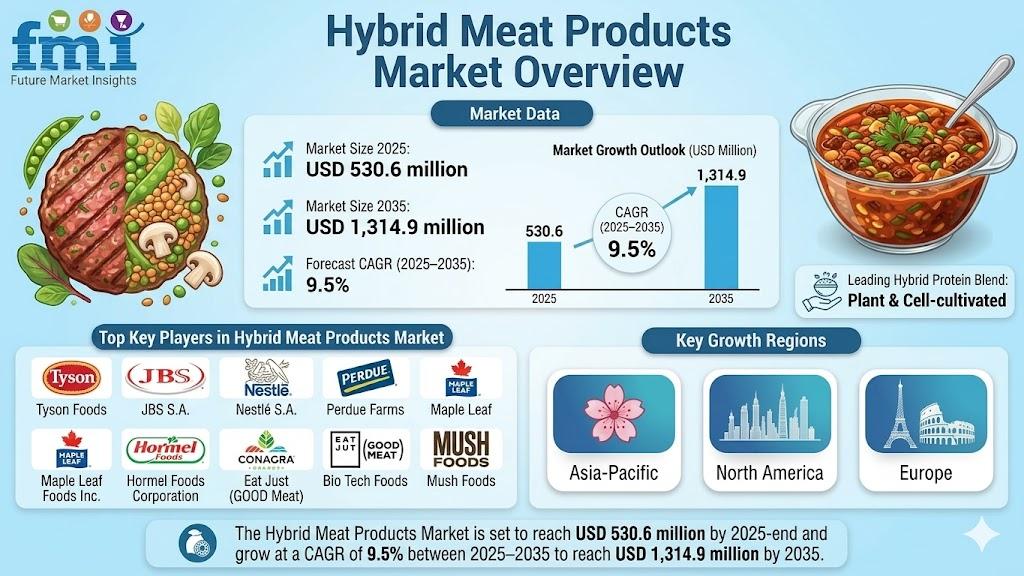
NEWARK, Del., USA | Jun 1, 2026 — According to Future Market Insights (FMI), the global hybrid meat products market is witnessing rapid expansion, supported by rising consumer demand for sustainable protein alternatives, growing interest in flexitarian diets, and increasing innovation in blended animal-plant protein formulations. The market is benefiting from heightened environmental awareness, advancements in protein processing technologies, and broader acceptance of products that combine the taste of conventional meat with the nutritional and sustainability advantages of plant-based ingredients.
Quick Stats Snapshot – Hybrid Meat Products Market
• 2025 Market Size: USD 530.6 million
• 2035 Forecast: USD 1,314.9 million
• CAGR (2025–2035): 9.5%
• Leading Product Type Segment: Burgers & Patties (26.7% share)
• Leading Source Segment: Beef-Based Hybrids (22.7% share)
• Incremental Opportunity (2025–2035): USD 784.3 million
• Fastest-Growing Markets: India (7.0% CAGR), China (6.7% CAGR)
👉 Get Detailed Market Forecasts, Competitive Benchmarking, and Pricing Trends: https://www.futuremarketinsights.com/reports/sample/rep-gb-26197
Market Size and Outlook
The global hybrid meat products market is projected to reach approximately USD 1.31 billion by 2035, growing from USD 530.6 million in 2025. Market expansion is being fueled by the convergence of environmental sustainability goals, evolving dietary preferences, and technological advancements in protein blending.
Hybrid meat products have emerged as a practical bridge between conventional meat consumption and plant-based alternatives, allowing consumers to reduce environmental impact without compromising taste, texture, or nutritional value.
The market is expected to grow steadily during the first half of the forecast period, supported by increasing consumer awareness and product availability, before accelerating significantly between 2030 and 2035 as affordability, scalability, and regulatory support improve.
Growth Drivers: Sustainability and Flexitarian Consumption Trends
The market is primarily supported by changing consumer attitudes toward protein consumption and sustainability.
• Environmental Sustainability Goals: Growing awareness of livestock-related emissions driving interest in lower-impact protein solutions
• Flexitarian Diet Adoption: Rising number of consumers reducing meat intake without fully eliminating animal protein
• Nutritional Enhancement: Hybrid formulations delivering balanced protein content, improved fiber levels, and reduced saturated fat
• Food Technology Advancements: Improvements in protein blending, flavor systems, and texture optimization technologies
• Mainstream Retail Expansion: Increasing shelf presence in supermarkets, hypermarkets, and foodservice channels supporting consumer trial
These factors continue to strengthen long-term opportunities across retail, foodservice, and direct-to-consumer distribution channels.
👉 Speak to Analyst: Customize insights for your business strategy: https://www.futuremarketinsights.com/customization-available/rep-gb-26197
Key Challenges: Cost Pressures and Consumer Perception Barriers
Despite strong growth prospects, several factors continue to influence market adoption:
• Premium Product Pricing: Hybrid products often remain more expensive than conventional meat alternatives
• Consumer Education Requirements: Limited understanding of hybrid protein concepts in emerging markets
• Supply Chain Complexity: Dependence on both meat and plant-protein ingredient sourcing networks
• Taste and Texture Expectations: Manufacturers must consistently meet consumer expectations for sensory performance
Companies investing in cost optimization, transparent labeling, and product innovation are expected to strengthen competitive positioning.
Opportunities: Retail Expansion and Protein Innovation
Significant opportunities are emerging across product development and market penetration initiatives.
• Ready-to-Eat Hybrid Meals: Expanding demand for convenient protein-rich meal solutions
• Foodservice Partnerships: Increasing collaboration with restaurants and quick-service chains
• Alternative Protein Integration: Growing incorporation of pea protein, soy protein, mycoprotein, and fermentation-derived ingredients
• Clean-Label Product Development: Consumer demand for recognizable ingredients and minimal additives
• Emerging Market Expansion: Growing awareness and accessibility across Asia-Pacific and Latin America
These developments are enabling manufacturers to diversify portfolios and expand consumer reach.
👉 Explore the Latest Food and Beverage Industry Analysis Now: https://www.futuremarketinsights.com/industry-analysis/food-and-beverage
Segmentation Insights: Burgers & Patties Lead Market Adoption
• Product Type Segment: Burgers & Patties dominate with 26.7% share due to consumer familiarity and strong retail presence
• Source Segment: Beef-Based Hybrids account for 22.7% share supported by consumer preference for traditional meat flavors
• Distribution Channel Segment: Supermarkets & Hypermarkets lead with 25.0% share through extensive product visibility and accessibility
• Ingredient Trend: Growing utilization of soy, pea, rice, and mycoprotein ingredients supporting product innovation
• Nutritional Positioning: High-protein and clean-label formulations remain key purchase drivers
Regional Analysis: Asia-Pacific and North America Drive Expansion
China is projected to remain among the fastest-growing hybrid meat products markets, supported by sustainability initiatives, urbanization, and protein diversification trends.
• China: Government support for sustainable food systems and strong e-commerce infrastructure driving adoption
• India: Rising health awareness and expanding metropolitan consumer base supporting market growth
• United States: Retail innovation, foodservice partnerships, and strong consumer awareness fueling demand
• Germany: Sustainability-focused consumers and advanced retail channels accelerating product penetration
• United Kingdom: Growing flexitarian population and environmental awareness supporting category expansion
• Brazil: Increasing demand for premium protein innovations creating new growth opportunities
Competitive Landscape: Innovation and Scalability Define Market Leadership
The hybrid meat products market remains moderately fragmented, with traditional meat companies, food manufacturers, and protein innovators competing across multiple segments.
Leading companies focus on:
• Expanding hybrid protein product portfolios across retail and foodservice
• Improving taste, texture, and nutritional performance through R&D investments
• Building partnerships with retailers and restaurant chains
• Enhancing production scalability and cost efficiency
• Strengthening sustainability messaging and consumer education initiatives
Competitive differentiation is increasingly based on affordability, product quality, supply chain resilience, and consumer trust.
Key Players
• Tyson Foods
• JBS S.A.
• Nestlé S.A.
• Perdue Farms
• Maple Leaf Foods Inc.
• Hormel Foods Corporation
• Conagra Brands
• Eat Just (GOOD Meat)
• Bio Tech Foods
• Mush Foods
👉 Unlock high-growth opportunities with FMI’s niche business market insights: https://www.futuremarketinsights.com/industry-analysis
Strategic Implications for Decision-Makers
The hybrid meat products market presents substantial growth opportunities supported by sustainability priorities, evolving consumer preferences, and advances in protein technology.
• Manufacturers should prioritize cost optimization and product formulation innovation
• Foodservice operators can capitalize on rising consumer interest in sustainable menu offerings
• Investors may benefit from accelerating growth in blended protein technologies and alternative protein ecosystems
• Retailers can leverage increasing demand for environmentally responsible protein products
As consumers increasingly seek balanced solutions between conventional meat and plant-based alternatives, hybrid meat products are expected to strengthen their position within the global protein landscape.
👉 Read Full Report: https://www.futuremarketinsights.com/reports/hybrid-meat-products-market
FAQs
What is the future size of the market?
The hybrid meat products market is projected to reach approximately USD 1.31 billion by 2035.
What is driving market growth?
Growth is driven by sustainability initiatives, flexitarian diet adoption, protein innovation, and increasing consumer demand for environmentally responsible food products.
Which product type segment dominates the market?
Burgers & Patties lead the market with a 26.7% share in 2025.
Which region shows the strongest growth?
China and India are among the fastest-growing markets globally, supported by rising awareness and expanding retail infrastructure.
Which source segment leads the market?
Beef-Based Hybrids dominate due to strong consumer familiarity and flavor preferences.
Have a Look at Related Research Reports on the Food & Beverage Domain
Nutrigenomic Market : https://www.futuremarketinsights.com/reports/nutragenomics-market
Flavonoid Market : https://www.futuremarketinsights.com/reports/flavonoid-market
Fruit Snacks Market : https://www.futuremarketinsights.com/reports/fruit-snacks-market
About Future Market Insights (FMI)
Future Market Insights (FMI) is a leading provider of market intelligence and consulting services, serving clients in over 150 countries. Headquartered in Newark, with a global delivery center in Pune and offices in the UK and UAE, FMI delivers actionable insights across industries including food & beverage, healthcare, chemicals, and consumer goods.
An ESOMAR-certified organization, FMI provides data-driven insights to support strategic decision-making for global businesses.
Contact Us
Future Market Insights Inc.
Christiana Corporate, 200 Continental Drive,
Suite 401, Newark, Delaware - 19713, USA
T: +1-347-918-3531
For Sales Enquiries: [email protected]

 English
 Arabic
 French
 Spanish
 Portuguese
 Deutsch
 Turkish
 Dutch
Dutch
 Italiano
 Russian
 Portuguese (Brazil)
 Greek
Greek