


The Torsional Backbone: How Vehicle Anti-Roll Bar Systems Control Body Motion
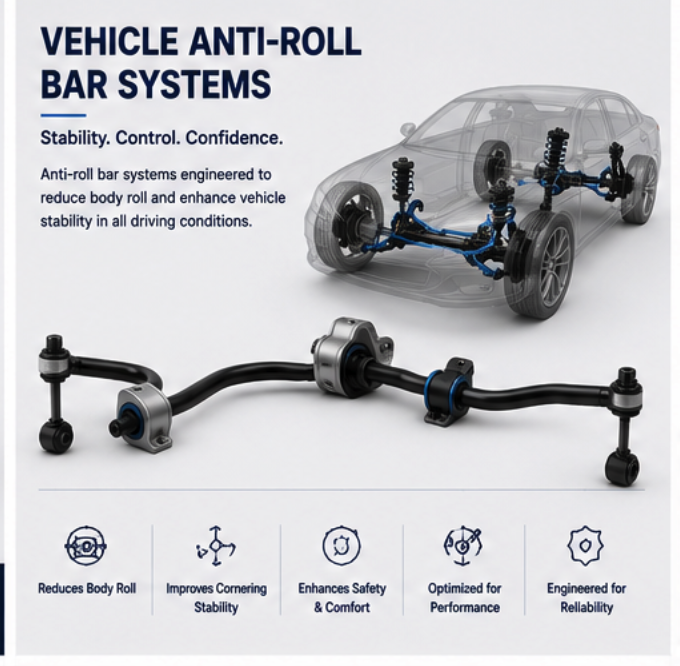
When a car enters a corner, physics tries to roll the body toward the outside of the turn. Left unchecked, this roll would lift the inside tires, reducing grip and eventually causing the vehicle to tip. Preventing this is the job of Vehicle Anti-Roll Bar Systems. These seemingly simple U-shaped steel bars are actually sophisticated torsion springs that connect the left and right wheels, transferring force across the axle to keep the vehicle flat. Understanding how they work—and how Hollow Sway Bar Technology improves them—is essential for anyone interested in vehicle dynamics.
The Physics of Body Roll
When a vehicle corners, centrifugal force acts at the center of gravity (CG). The suspension compresses on the outside wheels and extends on the inside wheels. This difference in suspension travel is "body roll."
Body roll is not inherently bad; some roll provides the driver with feedback about cornering forces. However, excessive roll has negative consequences:
-
Reduced tire grip: Camber angles change as the body rolls, reducing the tire's contact patch.
-
Delayed response: The vehicle feels lazy, taking time to "take a set" in the corner.
-
Passenger discomfort: Excessive lean is unsettling.
-
Reduced stability: In extreme cases, the inside tires may lift off the ground.
Vehicle Anti-Roll Bar Systems counteract these effects by providing a resistance torque that opposes body roll.
How an Anti-Roll Bar Works
The anti-roll bar (also called stabilizer bar or sway bar) is a U-shaped torsion spring. The center section is mounted to the chassis via rubber bushings. The ends connect to the left and right suspension control arms (or struts) via end links.
In a straight line, both wheels move together (over a bump), and the bar rotates in its bushings without twisting. The bar provides no resistance. However, in a corner, the outside suspension compresses while the inside extends. The ends of the bar move in opposite directions—one up, one down—twisting the center section.
The bar's resistance to twisting provides a torque that tries to return the ends to the same height. This torque is transmitted to the suspension, reducing the difference in wheel travel and thus reducing body roll.
Key Anti-Roll Bar Parameters
Engineers tune anti-roll bars using several parameters:
| Parameter | Effect |
|---|---|
| Bar diameter | Stiffness increases with the fourth power of diameter |
| Bar length (arm length) | Shorter arms = stiffer bar |
| Bar shape | Straight sections vs. bends affect stiffness |
| Wall thickness (hollow bars) | Thinner walls reduce weight but maintain stiffness |
| Material | Steel vs. aluminum vs. composite |
The torsional stiffness of a solid bar is proportional to D⁴ (diameter to the fourth power). This means a small increase in diameter dramatically increases stiffness:
-
Increase diameter from 20mm to 22mm (+10%) = stiffness increases by 46%
-
Increase diameter from 20mm to 25mm (+25%) = stiffness increases by 144%
This sensitivity allows engineers to fine-tune handling with small diameter changes.
Roll Stiffness Distribution
The front and rear anti-roll bars work together to determine the vehicle's handling balance. The distribution of roll stiffness between axles controls whether the vehicle understeers (front loses grip first) or oversteers (rear loses grip first).
-
More front bar stiffness: Increases front roll stiffness → more understeer.
-
More rear bar stiffness: Increases rear roll stiffness → more oversteer.
Manufacturers typically tune production cars for mild understeer (safe, predictable). Performance cars may have adjustable bars that allow the driver to change the balance.
Hollow Sway Bar Technology: Lighter, Stiffer, Better
Traditional anti-roll bars are solid steel rods. Hollow Sway Bar Technology replaces the solid core with a hollow tube. As discussed earlier, a hollow bar can achieve the same torsional stiffness as a solid bar with significantly less weight.
Why does weight matter for an anti-roll bar? Because the bar is part of the unsprung mass (or partially unsprung, depending on mounting). Weight savings here improve suspension responsiveness.
Hollow Bar Design Considerations:
-
Diameter: Must be larger than a solid bar of equivalent stiffness.
-
Wall thickness: Typically 3-6 mm. Thinner walls save more weight but risk buckling.
-
Material: High-strength steel (30-40% stronger than standard steel) allows even thinner walls.
-
End treatments: The bar ends (where connections attach) are often solid (swaged) for strength.
Real-World Performance Comparison
Let us examine a typical front anti-roll bar for a mid-size sedan:
| Specification | Solid Bar | Hollow Bar |
|---|---|---|
| Diameter | 24 mm | 28 mm |
| Wall thickness | Solid | 4.5 mm |
| Torsional stiffness | 100% | 98% |
| Weight | 5.2 kg | 3.1 kg |
| Weight savings | - | 40% |
| Cost | Base | +25% |
The hollow bar saves 2.1 kg (4.6 lbs) while maintaining essentially the same performance. Multiply this by millions of vehicles, and the fuel savings are substantial.
Manufacturing Hollow Anti-Roll Bars
Producing hollow sway bars requires precision manufacturing:
-
Tube forming: A steel tube is cut to length. For seamless tubes, a solid billet is extruded. For welded tubes, a strip is roll-formed and seam-welded.
-
Bending: The tube is bent into the U-shape using CNC benders. Mandrels inside the tube prevent kinking.
-
End forming: The ends are swaged (forged) to solid cross-sections, creating attachment points.
-
Heat treatment: The bar is heated and quenched to achieve the desired hardness and strength.
-
Shot peening: Small steel beads bombard the surface, inducing compressive stresses that prevent crack initiation.
-
Coating: E-coating or powder coating provides corrosion protection.
Active Anti-Roll Bar Systems
The ultimate evolution of Vehicle Anti-Roll Bar Systems is active (or "dynamic") systems. These use actuators to vary bar stiffness or even apply torque independently to each wheel.
Active systems offer:
-
Zero roll: The vehicle remains flat even in extreme corners.
-
Variable stiffness: Soft for ride comfort, stiff for handling—automatically.
-
Individual wheel control: Can counteract potholes without affecting the other wheel.
However, active systems are heavy, complex, and expensive. They are currently limited to high-end luxury and performance vehicles.
Maintenance and Failure Modes
Anti-roll bars are generally reliable, but they can fail:
-
Bushing wear: The rubber bushings that mount the bar to the chassis deteriorate. Symptoms: clunking noise over bumps.
-
End link failure: The ball joints at the bar ends wear. Symptoms: rattling, loose handling.
-
Bar cracking: Fatigue cracks can initiate at stress risers (nicks, scratches). Symptoms: progressive handling degradation.
-
Corrosion: Rust can weaken the bar, especially at attachment points.
Regular inspection (every 50,000 miles) of bushings, end links, and bar condition is recommended.
The Future of Anti-Roll Bar Technology
The market for Hollow Sway Bar Technology is growing rapidly. Key trends include:
-
Wider adoption: What was once premium is becoming standard.
-
Aluminum bars: Lighter than steel, increasingly common in EVs.
-
Composite bars: Carbon fiber for ultimate performance.
-
Integrated systems: Bars designed as part of complete lightweight suspension modules.
Conclusion
The humble anti-roll bar is a masterpiece of mechanical engineering—simple in concept but sophisticated in execution. Vehicle Anti-Roll Bar Systems keep tires planted, bodies flat, and drivers confident. Hollow Sway Bar Technology has made these components lighter without compromising performance, contributing to the ongoing quest for vehicle efficiency. Next time you take a corner with confidence, thank the torsional backbone working beneath the floor.

 English
 Arabic
 French
 Spanish
 Portuguese
 Deutsch
 Turkish
 Dutch
Dutch
 Russian
 Romaian
 Portuguese (Brazil)
 Greek
Greek