


The Keystone of the Crankshaft: Understanding Crankshaft Support Bearing Caps
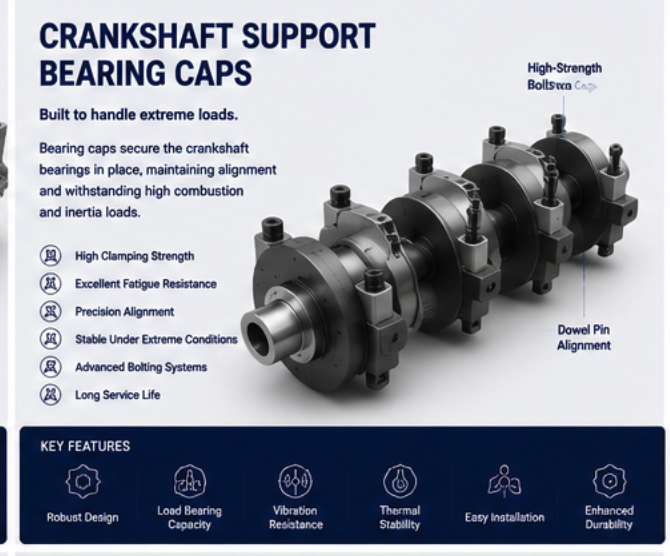
The crankshaft is the backbone of an internal combustion engine, and bearing caps are the keystones that hold it firmly in place. These simple-looking components are actually highly engineered parts that must withstand immense forces while maintaining precise alignment. From the basic cast iron caps in a family sedan to the billet steel girdles in a top-fuel dragster, the design and integrity of bearing caps are critical to engine survival.
Crankshaft Support Bearing Caps complete the Engine Bearing Housing Components by forming the lower half of the bearing housing. They are machined together with the engine block to ensure a perfectly round bore. Understanding their interaction with Internal Combustion Engine Components and Precision Engine Bearing Technology is essential for engine builders. They are a vital part of any comprehensive engine assembly, working with the block to precisely locate and support the crankshaft.
The Role of the Bearing Cap
Bearing caps serve several essential functions in an engine. They hold the crankshaft by forming a clamp around the crankshaft journal along with the main bearing journal in the block. The bearing insert sits between the crankshaft and the cap/block, providing a low-friction surface. They also apply bearing crush, as the bearing insert is slightly oversized and is compressed into its bore when the cap is torqued down, ensuring a tight fit and preventing it from spinning. Additionally, bearing caps maintain alignment, as they are precisely machined to ensure the crankshaft remains perfectly aligned, preventing crankshaft flex and bearing wear.
Bearing Cap Design and Variations
Bearing caps are not all the same, with design varying based on the engine's application and power level. Two-bolt main caps are the most common design, used in most production engines, with two bolts per cap securing it to the engine block. Four-bolt main caps use four bolts to secure the cap to the block, with two vertical bolts and two angled cross-bolts, providing significantly more clamping force to prevent cap walk under high loads. Cross-bolted main caps are a variation where, in addition to vertical bolts, horizontal bolts pass through the side of the block into the bearing cap, offering a very robust design often used in high-powered diesel engines. For extreme high-performance applications, billet caps are machined from a solid billet of steel, offering maximum strength and allowing for custom designs.
Fastening Systems
The bolts or studs that secure the bearing caps are just as important as the caps themselves. Main bolts are the standard fasteners threaded directly into the engine block, often made from high-strength alloys and heat-treated in high-performance engines. Main studs are an alternative to bolts, threading into the block with a nut used to clamp the bearing cap, often preferred in performance engines for more consistent and precise clamping force. The torque applied to the main bolts/studs is critical, as under-torquing can lead to bearing cap walk and failure, while over-torquing can stretch or break the fastener or distort the bearing bore.
Materials and Manufacturing
Crankshaft support bearing caps are made from various materials. Cast iron is the standard for most production engines, being strong, durable, and cost-effective. Ductile iron is a stronger type of cast iron offering better fatigue resistance, used in some performance engines. Forged steel is the choice for high-performance and racing engines, providing superior strength and impact resistance. Billet steel offers the ultimate in strength, machined from a solid piece of steel for the best possible material properties.
Maintenance and Inspection
Bearing caps require careful inspection during engine assembly or rebuild. This includes a visual inspection for cracks, scoring, or damage; checking surface flatness with a straightedge and feeler gauge; inspecting bolt/stud threads for damage or stretching; and measuring the inside diameter of the bearing housing with the cap torqued to spec.
Conclusion
Crankshaft Support Bearing Caps are fundamental to engine integrity. Their design, material, and fastening are critical for maintaining the precise alignment of the crankshaft. Understanding the role of these components, along with Engine Bearing Housing Components, Precision Engine Bearing Technology, and Internal Combustion Engine Components, is essential for engine builders and enthusiasts who want to build a reliable and powerful engine.

 English
 Arabic
 French
 Spanish
 Portuguese
 Deutsch
 Turkish
 Italiano
 Russian
 Romaian
 Portuguese (Brazil)
 Greek
Greek