


Education Leadership for Systemic Change: A Shikshagraha Perspective
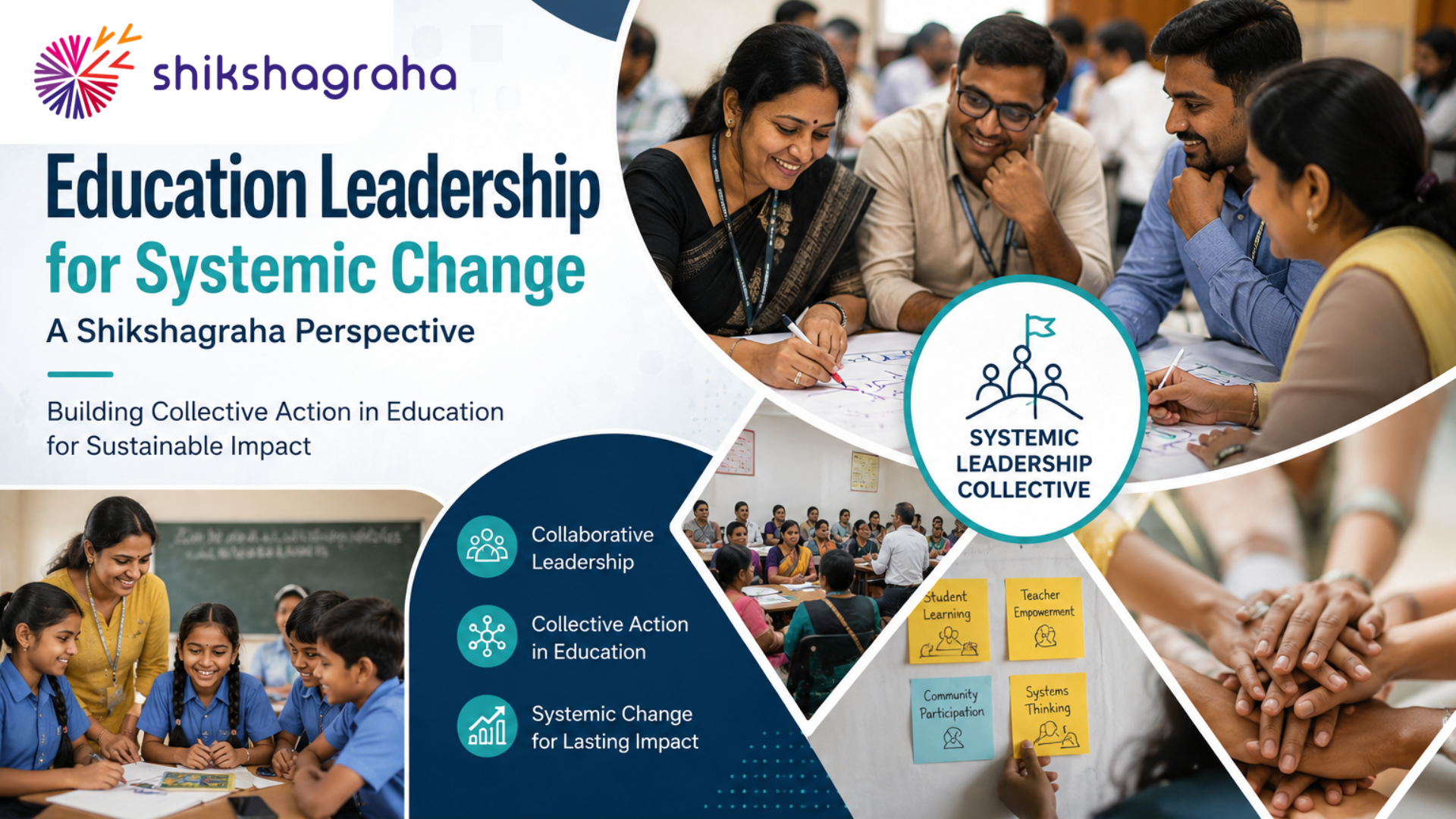
Education leadership is evolving beyond individual school management into a broader vision of system-wide transformation. In today’s rapidly changing learning ecosystem, education leadership, Shikshagraha and collective action in education together form a powerful framework for sustainable impact.
Shikshagraha focuses on enabling systemic leadership collectives that bring educators, institutions, and communities together to improve learning outcomes at scale. This approach ensures that education leadership is not isolated but deeply connected with collaboration and shared responsibility.
At its core, collective action in education strengthens the foundation of long-term educational transformation.
Education leadership in transforming systemic change
Modern education leadership is no longer limited to administrative decision-making; it is about influencing systems, mindsets, and practices across multiple layers of education. Leaders today must think beyond classrooms and focus on ecosystem-level improvements.
Key elements of effective education leadership include:
-
Building a shared vision across schools and stakeholders
-
Strengthening teacher capacity through continuous learning
-
Encouraging data-informed decision-making
-
Creating inclusive environments for all learners
-
Driving innovation in teaching and learning methods
Within the Shikshagraha ecosystem, education leadership is positioned as a collaborative force rather than a hierarchical structure. Leaders are encouraged to co-create solutions, ensuring that change is not dependent on a single authority but distributed across networks. This model strengthens ownership and accountability at every level.
Collective action in education for sustainable impact
Collective action in education plays a crucial role in addressing systemic challenges such as learning gaps, inequality, and resource limitations. Instead of isolated interventions, collective approaches bring together educators, policymakers, NGOs, and communities to co-design solutions.
Some key dimensions of collective action include:
-
Shared accountability for student outcomes
-
Cross-school collaboration and peer learning networks
-
Community engagement in school development
-
Alignment of policies with ground-level realities
-
Continuous feedback loops for improvement
When collective action in education is implemented effectively, it leads to stronger resilience within the education system. It ensures that no single institution works in isolation and that knowledge is continuously shared and improved. In the Shikshagraha model, this collective approach becomes the backbone of sustainable transformation.
Shikshagraha systemic leadership collective approach
The Shikshagraha framework represents a shift from individual leadership to systemic leadership collectives. It is designed to empower educators and institutions to work together toward long-term educational transformation. Through this approach, education leadership becomes a shared responsibility that evolves through collaboration and continuous learning.
Shikshagraha’s systemic leadership model focuses on:
-
Strengthening leadership capacity across all levels of the education system
-
Encouraging experimentation and innovation in schools
-
Building trust-based partnerships among stakeholders
-
Enabling scalable solutions for education challenges
-
Promoting equity and inclusion in learning environments
By integrating collective action in education, Shikshagraha ensures that every stakeholder contributes meaningfully to system improvement. This creates a strong network of leaders who are aligned in purpose and action, driving consistent progress across regions and institutions.
Conclusion
The future of education depends heavily on how effectively systems can embrace collaboration, innovation, and shared responsibility. Education leadership must evolve into a collective force that empowers communities rather than working in isolation. Through collective action in education, stakeholders can address deep-rooted challenges and build sustainable solutions that benefit every learner.
Shikshagraha stands as a strong example of how systemic leadership collectives can reshape the education landscape. By integrating collaboration, shared vision, and continuous improvement, it reinforces the idea that meaningful change is only possible when everyone works together. Ultimately, the combination of education leadership, collective action in education, and Shikshagraha’s systemic approach creates a powerful pathway toward lasting educational transformation.

 English
 Arabic
 French
 Spanish
 Portuguese
 Deutsch
 Turkish
 Dutch
Dutch
 Italiano
 Russian
 Romaian
 Portuguese (Brazil)