


Who Should Use Modafinil 100mg? Approved Uses Explained (2026 Guide)
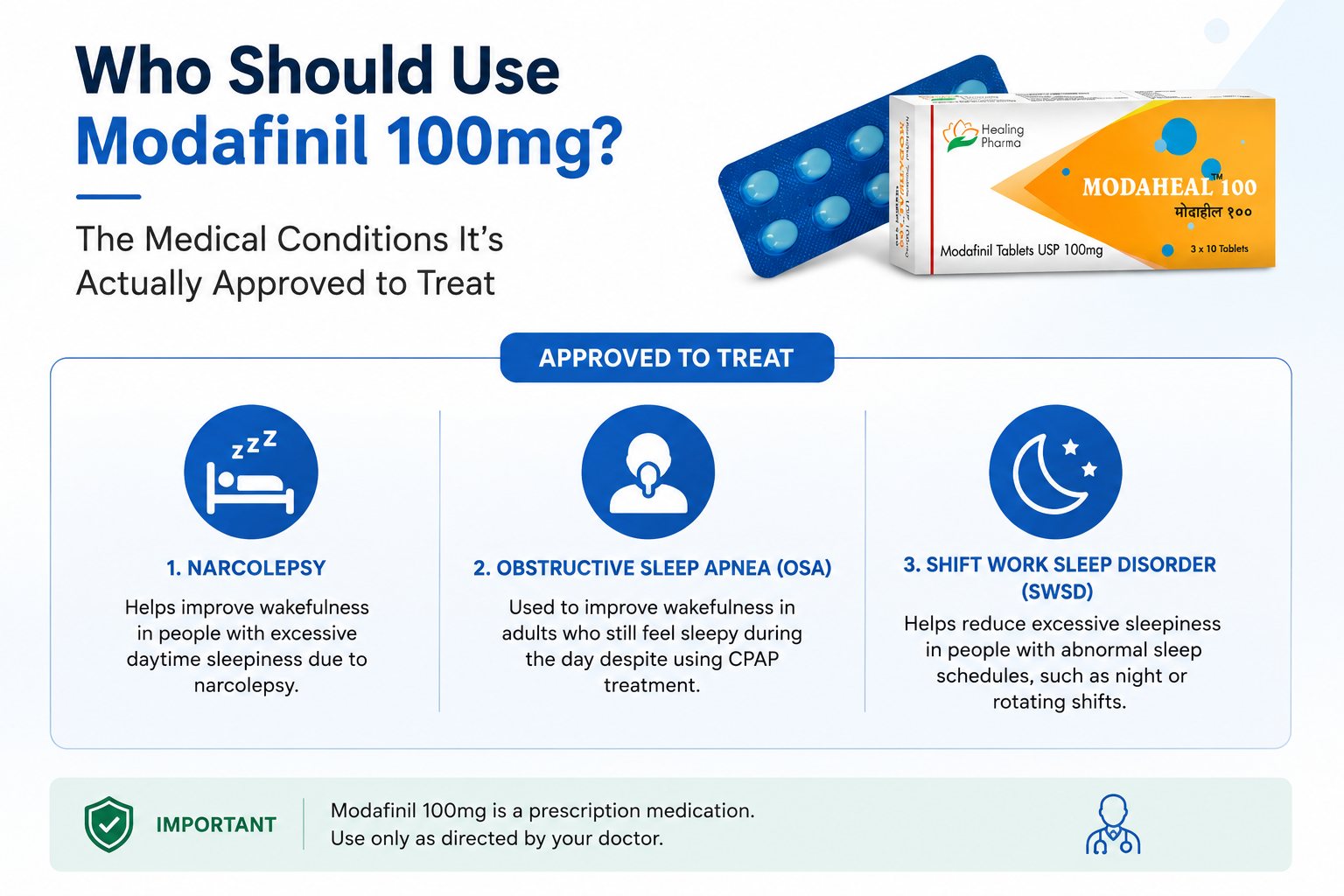
Who Should Use Modafinil 100mg? The Medical Conditions It's Actually Approved to Treat
Most people land on this question after a rough week. Maybe it's the third night shift in a row, or a sleep study that finally has a name for the exhaustion. Whatever the reason, the search is rarely casual; it's someone trying to figure out if this medication applies to them before they bring it up to a doctor.
Here's the part most guides skip: modafinil doesn't have a broad approval. It has three. And knowing exactly what those three are not the internet's expanded version of them- is what actually determines whether it's worth a conversation with your physician.
What Modafinil 100mg Actually Is
Modafinil is a prescription wakefulness-promoting agent. It doesn't sedate, and it isn't classified as a traditional stimulant like amphetamines, though it does affect the central nervous system to help the brain stay alert during hours the body would otherwise want to sleep.
The 100mg strength is one of the lower standard doses, often used for people just starting treatment or those whose sleep specialist determines a lighter dose is appropriate for their condition. That decision belongs to a prescriber, not a blog post; dosing depends on the specific disorder, response, and other medications involved.
The Three FDA-Approved Uses No More, No Less
This is where accuracy matters more than most content creators let on. The FDA has approved modafinil for exactly three conditions:
|
Approved Condition |
What It Is |
Why Wakefulness Matters |
|
Narcolepsy |
A neurological disorder causing sudden, uncontrollable episodes of sleep during the day |
Helps sustain wakefulness during normal waking hours |
|
Obstructive Sleep Apnea (OSA) |
Repeated airway blockages during sleep that fragment rest, used as an add-on, not a replacement for CPAP |
Addresses lingering daytime sleepiness after the airway issue is treated |
|
Shift Work Sleep Disorder |
Excessive sleepiness tied to a work schedule that conflicts with the body's natural sleep-wake cycle |
Supports alertness during scheduled work hours that fall outside normal sleep windows |
Notice what's missing from that list: general fatigue, studying for exams, jet lag, or working long hours by choice. Those uses exist in the real world; people talk about them constantly in forums and comment sections, but they fall outside the approved indications, which changes the entire risk and monitoring conversation.
What Most Blogs Miss
Search results are full of generic-brand product pages that read like they're describing a lifestyle supplement: energy, sharper focus, productivity. That framing quietly erases the fact that this is a controlled prescription medicine tied to diagnosed sleep disorders, evaluated and monitored by a physician.
Here's the psychological piece nobody names directly: when a product is easy to search and easy to order, the brain starts treating 'available' as a stand-in for 'appropriate for me.' It isn't. Availability is a supply-chain fact. Appropriateness is a medical determination that depends on your diagnosis, your other conditions, and your other medications.
That gap between what's easy to get and what you actually qualify for is the single most under-discussed issue in this entire content category. Most guides optimize for the purchase decision. Very few optimize for the diagnostic decision that has to come first.
Signs You Might Be a Candidate And Signs You're Not
You may be a reasonable candidate for evaluation if:
-
You've been formally diagnosed with narcolepsy, OSA, or shift work sleep disorder or you have strong, persistent symptoms and haven't yet been evaluated
-
Standard treatments for your condition (like CPAP for OSA) haven't fully resolved daytime sleepiness
-
Your sleepiness is measurably interfering with safety driving, operating equipment, or performing your job
A prescriber is more likely to flag concerns if:
-
You have a history of heart rhythm problems, uncontrolled high blood pressure, or certain psychiatric conditions
-
You're taking medications that interact with CNS-active drugs, including some hormonal contraceptives
-
Your goal is performance enhancement or general energy rather than managing a diagnosed sleep disorder
None of this replaces a real evaluation. It's a starting filter the kind of self-check that makes a doctor's appointment more productive, not a substitute for one.
The Hidden Truth About the 100mg Question
People searching for 'who should use modafinil 100mg' are often really asking a quieter question: Is what I'm feeling serious enough to treat? That's a valid thing to sit with. Chronic daytime sleepiness gets normalized, especially for shift workers and people juggling demanding schedules, until it starts costing something real: a near-miss while driving, a mistake at work, a relationship strained by constant exhaustion.
If any of that sounds familiar, the honest next step isn't researching a specific dose. It's getting a sleep evaluation, which is the only way to know which of the three approved conditions, if any, actually applies to you.
FAQs
Is modafinil 100mg approved for studying or work focus?
No. The FDA-approved uses are narcolepsy, obstructive sleep apnea, and shift work sleep disorder. Using it purely for cognitive enhancement falls outside approved indications and outside a prescriber's intended monitoring.
Can modafinil 100mg replace CPAP therapy for sleep apnea?
No. For OSA, modafinil is approved only as an add-on to standard treatment, not a replacement for CPAP or other airway therapies.
Do I need a sleep study before starting modafinil?
In most cases, yes. A formal diagnosis, often confirmed through a sleep study, is how a physician determines whether one of the three approved conditions applies to you.
Is 100mg a starting dose or a full treatment dose?
100mg is one of the lower standard strengths and is sometimes used as a starting point, but the right dose depends entirely on your diagnosis and prescriber guidance not a general rule.
Who should avoid modafinil altogether?
People with certain heart conditions, uncontrolled hypertension, or specific psychiatric histories are often flagged as higher-risk candidates. Only a prescriber reviewing your full medical history can make that call.
Medical Disclaimer: This article is for general educational purposes only and isn't medical advice. Talk to a licensed healthcare provider before starting, stopping, or changing any medication.

 English
 Arabic
 French
 Portuguese
 Deutsch
 Turkish
 Dutch
Dutch
 Italiano
 Russian
 Romaian
 Portuguese (Brazil)
 Greek
Greek