


How Automotive Semiconductors Are Powering the Future of Connected and Electric Vehicles
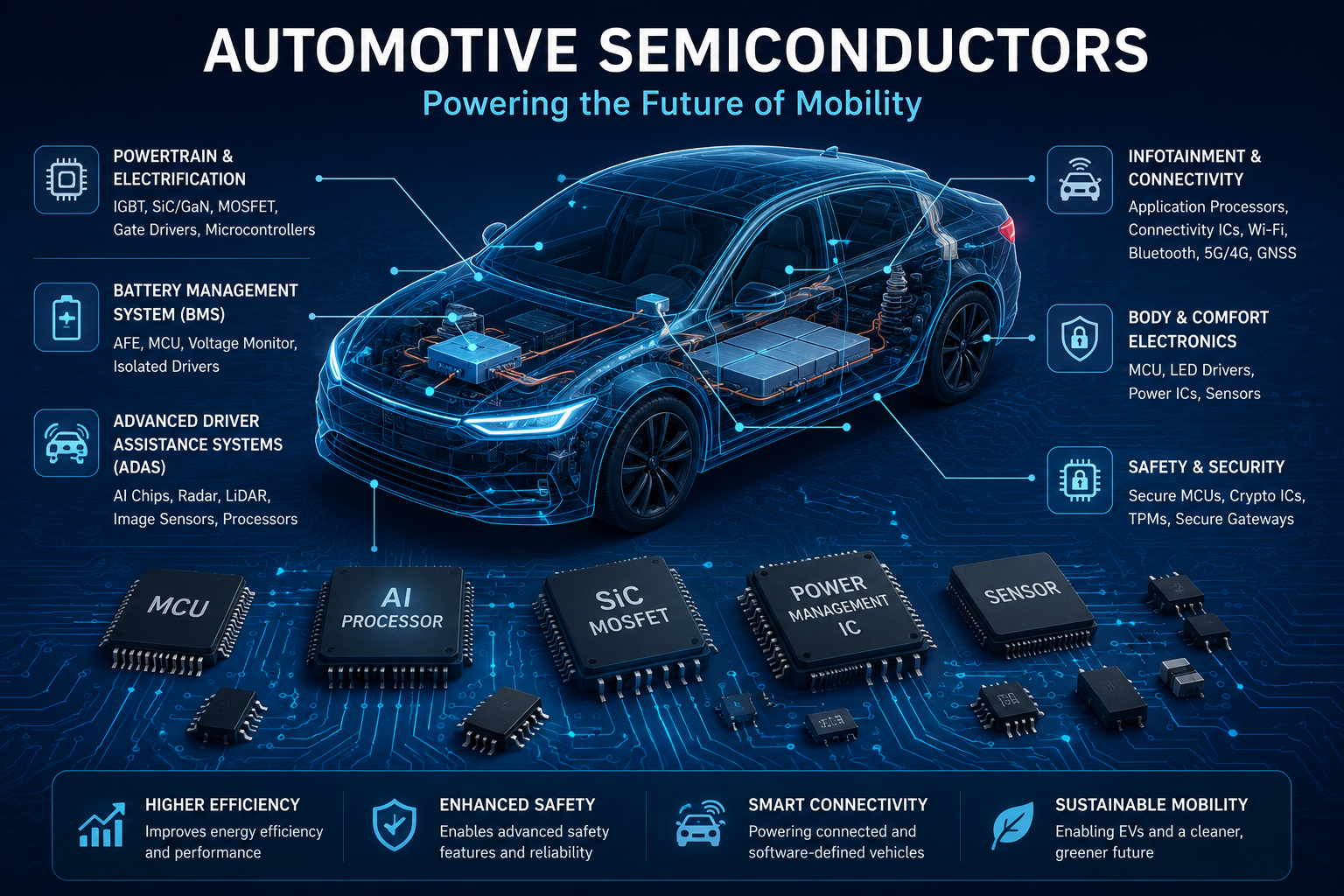
The automotive industry is undergoing one of the biggest technological transformations in its history, and automotive semiconductors are at the center of this evolution. As vehicles become increasingly electric, connected, autonomous, and software-defined, the demand for high-performance semiconductor chips continues to rise. From engine control and battery management to advanced driver assistance systems (ADAS) and infotainment, semiconductors enable virtually every intelligent function in modern vehicles.
The rapid adoption of electric vehicles (EVs) has significantly accelerated semiconductor demand. Electric vehicles require substantially more chips than conventional internal combustion engine vehicles due to their complex power electronics, battery management systems, inverters, onboard chargers, and thermal management solutions. Wide-bandgap semiconductor materials such as silicon carbide (SiC) and gallium nitride (GaN) are becoming increasingly important because they improve energy efficiency, reduce charging time, and extend vehicle range.
Another major growth driver is the increasing deployment of ADAS technologies. Features such as adaptive cruise control, automatic emergency braking, lane-keeping assistance, driver monitoring, and parking assistance depend on sophisticated processors, sensors, radar chips, LiDAR, and AI accelerators. As automakers move toward higher levels of autonomous driving, semiconductor content per vehicle is expected to increase substantially.
Download PDF Brochure -https://www.marketsandmarkets.com/pdfdownloadNew.asp?id=195
Software-defined vehicles (SDVs) are also reshaping semiconductor architectures. Instead of relying on dozens of independent electronic control units (ECUs), automakers are transitioning toward centralized computing platforms powered by high-performance processors. These advanced chips support over-the-air software updates, cybersecurity, vehicle connectivity, cloud integration, and AI-powered decision-making, enabling continuous feature enhancements throughout a vehicle’s lifecycle.
Connectivity technologies are another important contributor to semiconductor demand. Modern vehicles integrate 5G, Wi-Fi, Bluetooth, GPS, vehicle-to-everything (V2X), and cloud communication systems to deliver real-time navigation, predictive maintenance, fleet management, and connected services. These capabilities require advanced communication processors and networking semiconductors capable of handling large volumes of data securely and efficiently.
Artificial intelligence is becoming a defining feature of the automotive semiconductor landscape. AI-enabled chips process information from multiple cameras, radar sensors, ultrasonic sensors, and LiDAR systems in real time, allowing vehicles to recognize road conditions, pedestrians, traffic signs, and surrounding objects with remarkable accuracy. This capability enhances both vehicle safety and autonomous driving performance.
The industry is also investing heavily in supply chain resilience following the global semiconductor shortages experienced in recent years. Governments and manufacturers are expanding domestic chip manufacturing capacity while establishing long-term partnerships with semiconductor suppliers to ensure stable production. Strategic investments in fabrication facilities and advanced packaging technologies are expected to strengthen the global automotive semiconductor ecosystem.
Looking ahead, the automotive semiconductor market is poised for sustained growth as electrification, digitalization, and autonomous technologies continue to reshape transportation. Innovations in AI processors, power semiconductors, sensor fusion, edge computing, and secure connectivity will further increase semiconductor content per vehicle. As automakers compete to deliver safer, smarter, and more energy-efficient vehicles, semiconductors will remain the foundation of next-generation mobility, driving innovation across the global automotive industry.

 English
 Arabic
 French
 Spanish
 Portuguese
 Deutsch
 Turkish
 Dutch
Dutch
 Italiano
 Romaian
 Portuguese (Brazil)
 Greek
Greek