


Petroleum Resins Market Outlook: C5 Resins and High-Performance Adhesives Drive Global Expansion
Key Highlights
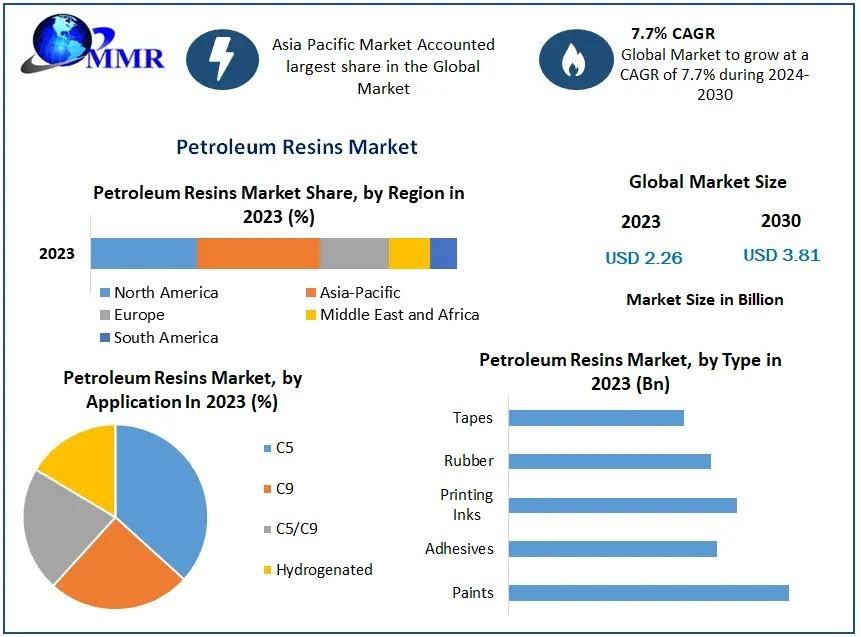
- The global Petroleum Resins Market was valued at USD 2.26 billion in 2023.
- Market revenue is expected to reach USD 3.81 billion by 2030, expanding at a 7.7% CAGR.
- Adhesives and sealants remain the largest application area due to increasing demand for high-performance bonding solutions.
- C5 petroleum resins dominated the product segment due to strong adhesion, low volatility, and improved aging resistance.
- Automotive remains the leading end-user industry because petroleum resins improve rubber performance and tire durability.
- Asia Pacific holds the largest market share due to strong manufacturing growth in China, India, Japan, and South Korea.
- Sustainability regulations are pushing manufacturers toward hydrogenated and low-emission resin technologies.
Why This Matters Now
The petroleum resins Market industry is becoming increasingly important as manufacturers across automotive, packaging, construction, and consumer goods sectors demand stronger bonding and coating materials.
Hydrocarbon resins act as performance-enhancing additives in adhesives and sealants. They improve tack, adhesion strength, water resistance, and high-temperature stability. These characteristics make them essential in products ranging from automotive tires and industrial tapes to packaging materials.
The shift toward lightweight vehicles, e-commerce packaging growth, and advanced manufacturing processes is increasing demand for specialized resin solutions.
At the same time, environmental regulations are forcing producers to improve product sustainability. Companies are investing in hydrogenated resins and cleaner production methods to meet changing regulatory requirements.
Market Overview
Petroleum resins are synthetic hydrocarbon-based resins produced from petroleum-derived feedstocks. They are primarily used as tackifiers that enhance adhesive performance and improve compatibility between different materials.
The market serves multiple industries, including:
- Adhesives and sealants
- Automotive
- Packaging
- Printing inks
- Rubber products
- Paints and coatings
- Personal hygiene products
Demand growth is driven by increasing use of pressure-sensitive adhesives, specialty tapes, and industrial bonding solutions.
The automotive sector represents a major consumption center as petroleum resins improve rubber compound performance by increasing modulus, durability, and resistance to mechanical stress.
However, market expansion faces challenges from environmental regulations, sustainability concerns, and the transition toward bio-based alternatives.
Manufacturers are responding by developing hydrogenated petroleum resins that offer improved environmental performance, lower odor, and better stability.
Explore detailed analysis, insights, and growth opportunities : https://www.maximizemarketresearch.com/request-sample/20961/
Key Trends Driving Growth
Adhesives and Sealants Drive Consumption Growth
Adhesives represent the largest application area for petroleum resins.
Manufacturers use petroleum resins as tackifiers to improve:
- Initial adhesion
- Peel strength
- Cohesion balance
- Heat resistance
- Water resistance
Growth in packaging, construction, automotive assembly, and hygiene products is increasing demand for advanced adhesive systems.
Automotive Production Supports Resin Demand
The automotive industry remains one of the strongest demand drivers.
Petroleum resins are used in rubber compounding applications to improve tire performance and resistance to wear.
Growth in automotive manufacturing across Asia Pacific, particularly China, India, Japan, and South Korea, is strengthening resin consumption.
The increasing adoption of electric vehicles is also creating demand for lightweight bonding solutions and specialized materials.
Hydrogenated Resins Gain Market Attention
Hydrogenated petroleum resins are expected to record strong growth due to their improved stability, low odor, and environmental advantages.
These resins are increasingly preferred in applications requiring high purity and reliability, including personal hygiene products, medical adhesives, and premium packaging materials.
Sustainability Pressures Reshape Product Development
Environmental regulations are influencing resin manufacturers to improve production processes and develop cleaner alternatives.
Companies are focusing on reducing emissions, improving recyclability, and developing products compatible with sustainable manufacturing goals.
This shift is creating opportunities for companies with advanced resin technologies.
Segment Insights
C5 Resin Segment Maintains Market Leadership
Based on product type, the market is segmented into:
- C5
- C9
- C5/C9
- Hydrogenated resins
The C5 resin segment dominated the market due to strong adhesion properties, low volatility, reduced odor, and excellent aging resistance.
C5 resins are widely used in:
- Adhesives
- Rubber products
- Packaging tapes
- Pressure-sensitive materials
Their balanced performance and cost efficiency make them the preferred choice across industrial applications.
C5/C9 Segment Shows Strong Growth Potential
C5/C9 blended resins are gaining demand because they combine the properties of aliphatic and aromatic resins.
These materials provide improved compatibility, stronger adhesion, and enhanced performance in demanding applications.
Heavy industries and construction-related applications are expected to support segment expansion.
Adhesive Application Leads Market Demand
By application, petroleum resins are used in:
- Paints
- Adhesives
- Printing inks
- Rubber
- Tapes
Adhesives and sealants held a major market share due to rising consumption in packaging, automotive, and industrial manufacturing.
The growth of flexible packaging and pressure-sensitive labels continues to strengthen demand for petroleum resin-based adhesives.
Automotive Remains the Leading End User
The automotive sector dominated the end-user segment.
Petroleum resins improve rubber properties used in tires and automotive components, supporting durability and performance.
Growing vehicle production and increasing demand for advanced materials continue to support resin consumption.
Regional Growth Story
Asia Pacific Leads Global Market Expansion
Asia Pacific held the largest share of the Petroleum Resins Market in 2023.
The region benefits from:
- Expanding automotive production
- Growing industrial manufacturing
- Rising packaging demand
- Increased resin production capacity
China, India, Japan, and South Korea are major contributors due to strong automotive and chemical manufacturing ecosystems.
The region’s cost advantages and expanding industrial base continue attracting investment from global resin producers.
North America Benefits from Industrial Demand
North America remains an important market due to strong demand from automotive, packaging, and construction industries.
The region benefits from high consumption of adhesives, specialty coatings, and industrial bonding solutions.
Increasing investments in advanced manufacturing are supporting market stability.
Europe Focuses on Sustainable Resin Solutions
Europe is advancing toward environmentally responsible resin production.
Strict sustainability regulations are encouraging manufacturers to develop cleaner technologies and hydrogenated resin products.
The region continues to demand high-performance materials for automotive, packaging, and industrial applications.
Competitive Landscape
The Petroleum Resins Market includes global chemical manufacturers competing through product innovation, capacity expansion, and application-specific solutions.
Eastman Chemical Company maintains a strong position through advanced hydrocarbon resin technologies and specialty adhesive solutions.
Exxon Mobil Corporation and Total Cray Valley compete through large-scale production capabilities and diversified resin portfolios.
Kolon Industries and Zeon Corporation strengthen their market position through specialty resin development for automotive and industrial applications.
Chemical companies including BASF SE and The Dow Chemical Company focus on high-performance material solutions supporting adhesive and coating industries.
Competitive advantage is shifting toward companies that can deliver sustainable, high-performance resins while maintaining cost efficiency.
Recent Developments
- Petroleum resin manufacturers are expanding production capacity to meet rising adhesive and packaging demand.
- Companies are increasing investment in hydrogenated resin technologies for cleaner and higher-performance applications.
- Market participants are strengthening regional supply networks to support automotive and industrial customers.
- Resin producers are developing advanced formulations for specialty tapes, coatings, and sealants.
Future Outlook
The Petroleum Resins Market will favor manufacturers that combine sustainable resin innovation, regional production strength, and application-specific performance as industries demand stronger and cleaner adhesive solutions.
About Maximize Market Research
Maximize Market Research Pvt. Ltd. (MMR) is a global market research and consulting company that provides reliable, data-focused, and practical business insights. The firm serves a wide range of industries, including healthcare, pharmaceuticals, technology, automotive, electronics, chemicals, personal care, and consumer goods. Through market forecasts, competitive analysis, strategic consulting, and industry impact assessments, MMR helps organizations understand changing market conditions, identify growth opportunities, and make informed business decisions for long-term success.
Contact Us :
2nd Floor, Navale IT Park Phase 3
Pune Banglore Highway, Narhe
Pune, Maharashtra 411041, India
+91 9607365656
[email protected]

 English
 Arabic
 French
 Spanish
 Portuguese
 Deutsch
 Turkish
 Dutch
Dutch
 Italiano
 Russian
 Romaian
 Portuguese (Brazil)