


Global Chilled Beam System Market: Everything You Need to Know
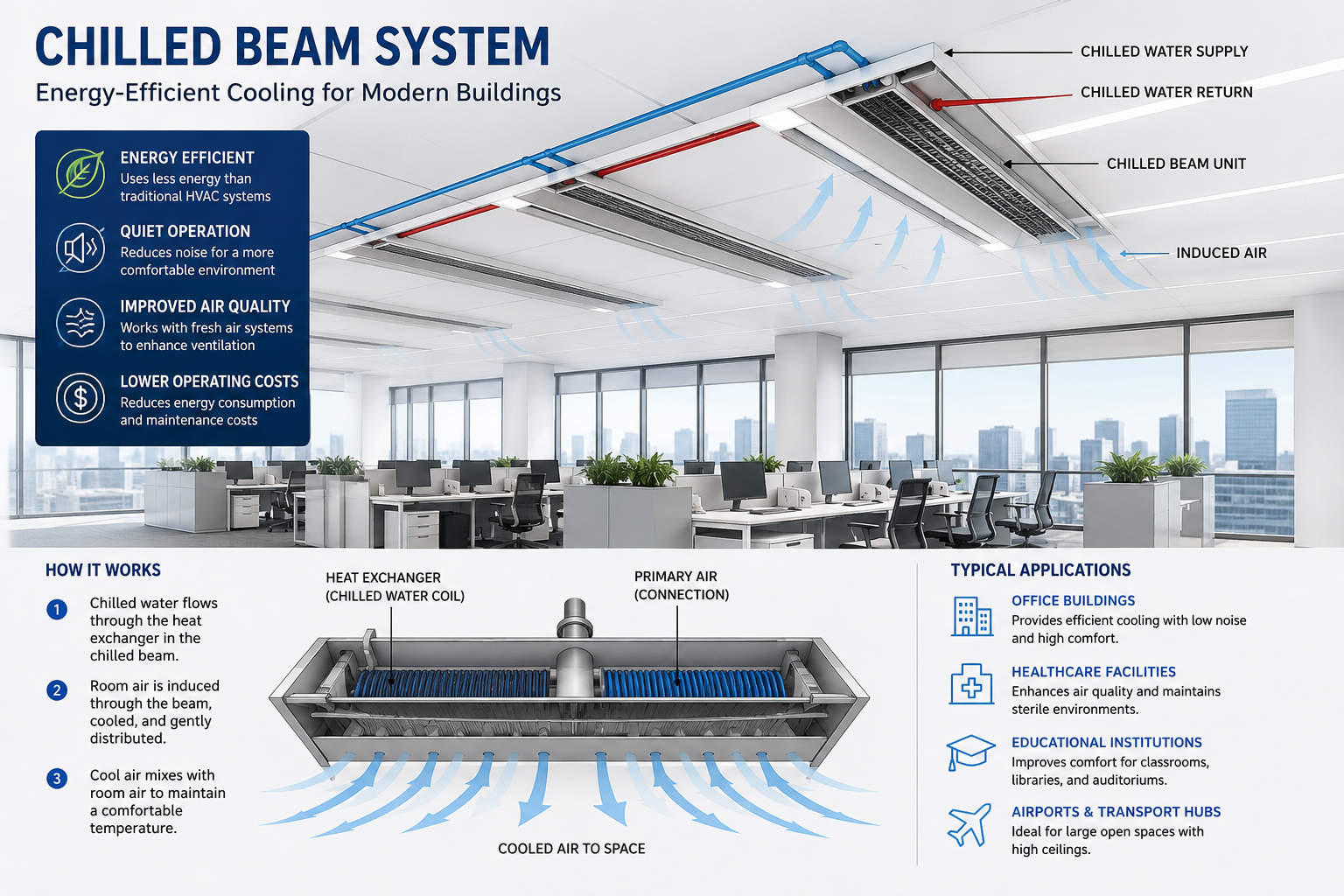
As the global construction industry embraces sustainability and energy efficiency, chilled beam systems are gaining momentum as an advanced HVAC (Heating, Ventilation, and Air Conditioning) solution for commercial and institutional buildings. Rising energy costs, stricter environmental regulations, and increasing demand for green buildings are encouraging architects, engineers, and facility managers to adopt cooling technologies that deliver superior performance with lower operating costs.
Unlike conventional air-conditioning systems that rely heavily on fans and large ductwork, chilled beam systems use water to transfer heat, significantly improving energy efficiency. Their quiet operation, enhanced indoor air quality, and compatibility with smart building technologies make them an ideal choice for modern offices, hospitals, educational institutions, airports, and hotels. As governments worldwide promote net-zero buildings and carbon reduction initiatives, the Chilled Beam System Market is expected to experience steady growth over the coming years.
What Is a Chilled Beam System?
A chilled beam system is a hydronic HVAC technology that cools or heats indoor spaces using ceiling-mounted units connected to chilled or heated water pipes. Because water can transport thermal energy much more efficiently than air, chilled beam systems require less fan power and smaller ductwork than traditional HVAC systems.
Download PDF Brochure -https://www.marketsandmarkets.com/pdfdownloadNew.asp?id=250787530
There are two primary types of chilled beam systems:
Active chilled beams use a supply of conditioned fresh air to induce room air through the beam, increasing cooling capacity while maintaining excellent ventilation.
Passive chilled beams rely on natural convection, allowing warm air to rise toward the ceiling where it is cooled before circulating back into the room.
Both systems offer excellent thermal comfort, reduced noise levels, and lower energy consumption, making them attractive for high-performance buildings.
Why Is the Chilled Beam System Market Growing?
Several factors are driving the expansion of the chilled beam system market.
Growing Demand for Sustainable Buildings
Green building certifications such as LEED, BREEAM, and WELL have become increasingly important for commercial construction projects. Developers are investing in energy-efficient HVAC technologies that help reduce carbon emissions while meeting stringent sustainability standards. Chilled beam systems contribute significantly to achieving these environmental goals by lowering overall building energy consumption.
Increasing Energy Costs
Electricity prices continue to rise across many regions, encouraging building owners to seek solutions that reduce operational expenses. Since chilled beam systems consume less fan energy than conventional HVAC systems, they can provide substantial long-term cost savings, making them a preferred investment for commercial facilities.
Expansion of Smart Buildings
Modern buildings are becoming increasingly connected through Building Management Systems (BMS), Internet of Things (IoT) sensors, and artificial intelligence (AI). Chilled beam systems integrate seamlessly with these technologies, enabling real-time monitoring, occupancy-based cooling, predictive maintenance, and optimized energy management.
Focus on Indoor Air Quality
Healthy indoor environments have become a top priority, particularly after the global pandemic. Chilled beam systems provide excellent ventilation when paired with Dedicated Outdoor Air Systems (DOAS), helping maintain comfortable temperatures while improving indoor air quality and occupant well-being.
Emerging Market Trends
Technological advancements are transforming the chilled beam system market.
One of the most significant trends is the integration of AI-powered HVAC controls. Intelligent algorithms analyze occupancy levels, weather conditions, and building usage patterns to optimize cooling performance while minimizing energy consumption.
Another emerging trend is the adoption of cloud-based building management platforms that allow facility managers to monitor HVAC performance remotely. Predictive maintenance tools can identify potential equipment issues before failures occur, reducing downtime and maintenance costs.
Manufacturers are also developing modular chilled beam solutions that simplify installation and make retrofit projects more practical for existing commercial buildings. Improved product designs, lightweight materials, and enhanced condensation control technologies are further expanding market opportunities.
Applications Across Multiple Industries
Chilled beam systems are being adopted across a wide range of sectors due to their energy efficiency and superior comfort.
Commercial office buildings use chilled beams to reduce operating expenses while creating productive work environments with low noise levels.
Hospitals and healthcare facilities benefit from improved indoor air quality, stable temperature control, and reduced airborne contaminants.
Educational institutions are increasingly adopting chilled beam technology to provide comfortable learning environments while lowering utility costs.
Hotels utilize chilled beam systems to improve guest comfort and reduce maintenance requirements.
Airports, research laboratories, government buildings, and mixed-use commercial developments are also investing in chilled beam technology as part of their sustainability strategies.
Regional Market Insights
Europe currently represents one of the largest markets for chilled beam systems due to strict energy-efficiency regulations, strong environmental policies, and widespread adoption of green building standards. Countries such as Germany, Sweden, the United Kingdom, and the Netherlands continue to invest heavily in sustainable construction.
North America is experiencing steady growth as commercial building owners modernize aging HVAC infrastructure and pursue carbon reduction goals. The United States and Canada are increasingly adopting smart building technologies that complement chilled beam installations.
The Asia Pacific region is expected to witness the fastest market growth over the next decade. Rapid urbanization, expanding commercial infrastructure, smart city initiatives, and increasing awareness of sustainable construction are driving demand in countries such as China, India, Japan, Singapore, and Australia.
The Middle East is also emerging as an attractive market due to the development of premium commercial buildings, airports, hospitals, and hospitality projects requiring energy-efficient cooling solutions.
Competitive Landscape
The chilled beam system market is highly competitive, with global manufacturers continuously investing in product innovation and digital technologies. Companies are focusing on improving cooling efficiency, reducing installation complexity, enhancing smart controls, and expanding their sustainable product portfolios.
Strategic partnerships with architects, HVAC consultants, and building automation providers are becoming increasingly important as integrated smart building solutions gain popularity. Manufacturers are also investing in research and development to improve condensation control, thermal performance, and compatibility with renewable energy systems.
Challenges Facing the Market
Despite strong growth potential, several challenges remain.
The higher initial installation cost compared to conventional HVAC systems can discourage adoption, particularly in cost-sensitive projects.
Proper system design is essential to prevent condensation, requiring experienced engineers and careful humidity management.
Retrofitting chilled beam systems into older buildings may require modifications to existing infrastructure, increasing project complexity.
However, advancements in design software, modular products, and smart controls are helping overcome these barriers and improving return on investment.
Future Outlook
The future of the Chilled Beam System Market looks highly promising as governments, businesses, and property developers prioritize sustainable construction and energy-efficient building technologies. Increasing investments in smart buildings, digital building management systems, and net-zero infrastructure will continue to drive market demand.
Artificial intelligence, IoT-enabled monitoring, predictive maintenance, and advanced building automation will further enhance the performance of chilled beam systems. As commercial buildings seek to reduce operational costs while improving occupant comfort and environmental performance, chilled beam technology is expected to become a core component of next-generation HVAC solutions.
Organizations investing in energy-efficient infrastructure today are likely to gain long-term financial benefits through lower energy consumption, reduced maintenance costs, improved indoor air quality, and compliance with evolving environmental regulations. With continuous technological innovation and growing awareness of sustainable construction practices, the chilled beam system market is well positioned for sustained global growth in the years ahead.

 English
 Arabic
 Spanish
 Portuguese
 Deutsch
 Turkish
 Dutch
Dutch
 Italiano
 Russian
 Romaian
 Portuguese (Brazil)
 Greek
Greek