


Data Center Cooling Tower Market Size Forecast to Reach US$ 1.8 Billion by 2032
Market Overview and Growth Outlook
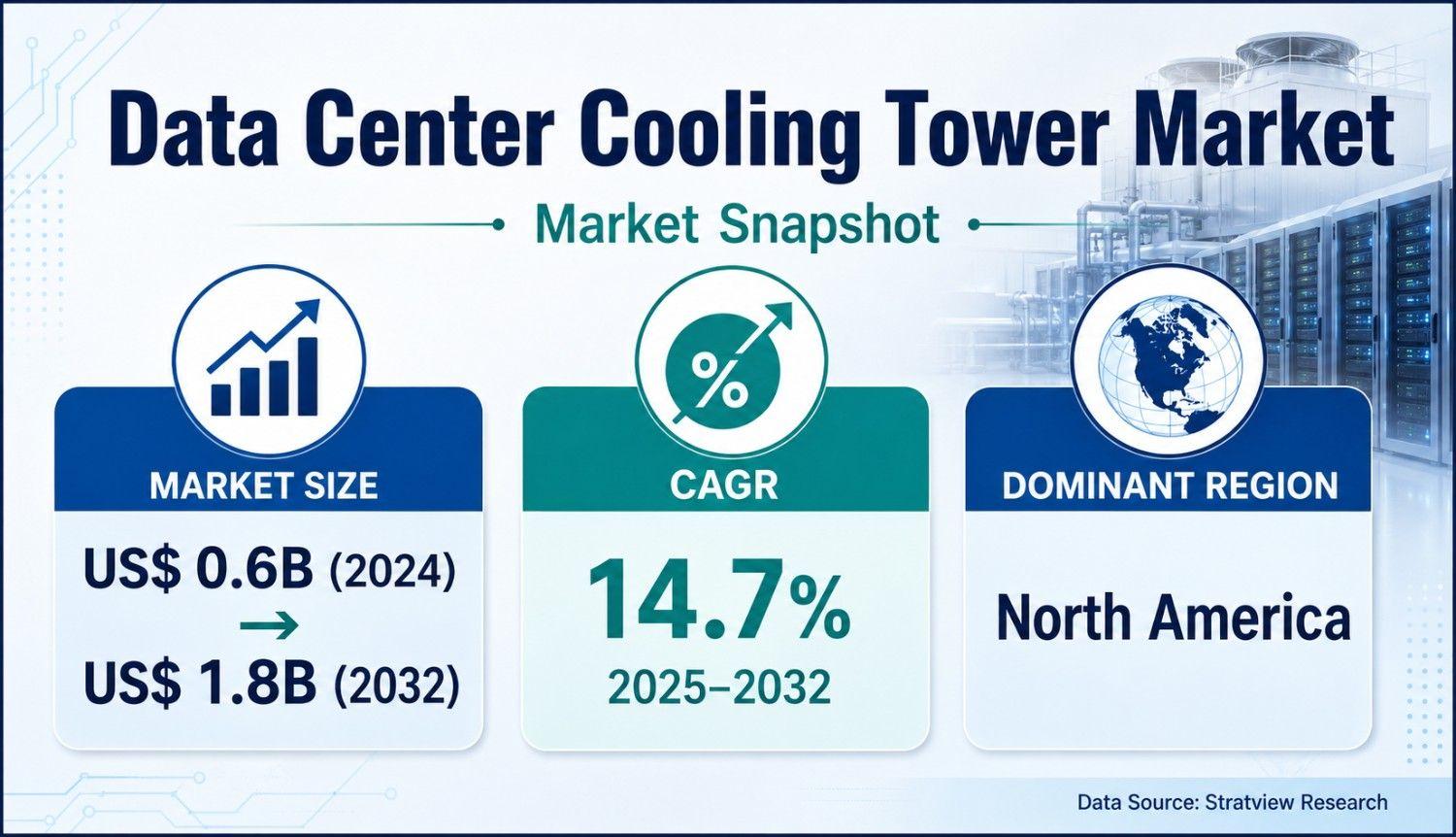
A threefold increase in market value defines the current Data Center Cooling Tower Market outlook. The industry was valued at US$ 0.6 billion in 2024 and is projected to reach US$ 1.8 billion by 2032 as digital facilities require greater heat-rejection capacity.
“The Data Center Cooling Tower Market is expected to grow at a CAGR of 14.7% during 2025–2032.” The forecast is supported by expanding cloud infrastructure, artificial intelligence workloads, high-performance computing, and increasing server densities across modern data centers.
Cooling towers transfer excess heat from water-cooled systems to the atmosphere. Working with chillers and condenser loops, they maintain temperatures required for IT reliability, uptime, and performance. Analysis of the Data Center Cooling Tower Market size shows how rising compute intensity is translating into demand for larger and more efficient thermal systems.
Request a free sample report:
https://www.stratviewresearch.com/Request-Sample/data-center-cooling-tower-market#form
Market Segmentation Analysis
By Data Center Type, the market is segmented into Hyperscale, Colocation, Enterprise, and Edge. Colocation leads this category as enterprises outsource infrastructure to improve scalability, cost efficiency, and operational agility. Shared space and resources allow customers to expand capacity while avoiding substantial direct capital investment.
High utilization and multi-tenant operations increase cooling complexity within colocation facilities. Systems must respond to changing rack densities and varied workloads while supporting strict uptime requirements. This operating model reinforces demand for centralized cooling infrastructure with sufficient redundancy and continuous heat-rejection capability.
Hyperscale is the fastest-growing data center category. Investment by global cloud service providers and the expansion of AI and data-intensive applications are generating substantial facility-level heat loads. Cooling towers enable the high-capacity, water-cooled architectures required to combine scalability, operational reliability, and long-term efficiency.
By Product Type, the market is segmented into Natural and Mechanical [Counter Flow Configuration and Cross Flow Configuration]. Natural cooling towers dominate because natural airflow enables high-load heat rejection with limited energy consumption. Their operating profile makes them suitable for large campuses with sufficient land and a focus on long-term efficiency.
Mechanical cooling towers are growing faster because their compact structure can fit urban and space-constrained projects. Precise temperature control and operational flexibility also support modular deployments. As data center capacity is installed closer to end users, these characteristics improve the segment’s relevance across varied facility designs.
By Tower System Type, the market is segmented into Wet and Dry. Wet cooling tower systems dominate because they deliver strong thermal efficiency and reliable heat rejection across changing loads. This performance supports critical environments where temperature stability directly affects equipment availability and operational continuity.
Dry cooling systems address water-management requirements by reducing or eliminating water consumption. Adoption is increasing selectively in water-scarce areas and locations facing tighter environmental constraints. Nevertheless, higher capital requirements and lower thermal efficiency compared with wet cooling continue to restrict broader deployment.
Regional Market Insights
North America maintains market leadership because it combines established digital infrastructure with a large concentration of hyperscale and colocation facilities. The region’s early adoption of advanced cooling technologies and continued investment by cloud providers sustain demand for cooling towers in both new construction and facility modernization.
Asia-Pacific records the fastest regional growth. Data center development and cloud adoption are advancing rapidly, while digitalization across China, India, and Southeast Asia is encouraging investment in hyperscale and edge infrastructure. Expanding enterprise demand and internet usage further support requirements for scalable cooling capacity.
Emerging Trends Shaping the Data Center Cooling Tower Market
Thermal infrastructure is increasingly evaluated through both performance and efficiency criteria. Cooling towers enhance chiller performance and reduce total power consumption, enabling operators to improve Power Usage Effectiveness while maintaining the stable operating conditions required by high-density computing environments.
The development of hybrid cooling towers and optimized water-management systems demonstrates the market’s response to environmental and operating constraints. Integration with free cooling technologies creates additional opportunities to balance heat-rejection performance, cost control, water use, and emissions-related objectives.
Liquid cooling is changing the distribution of heat within data centers, but it does not remove the need for facility-level heat rejection. Direct-to-chip, immersion, and rear-door technologies often connect to hybrid or water-cooled loops, maintaining cooling towers as important components within advanced thermal architectures.
Key Growth Drivers of the Market
- Higher server density: Denser computing infrastructure raises facility heat loads, requiring more capable and dependable heat-rejection systems.
- Cloud infrastructure growth: Cloud service expansion drives large data center projects that depend on centralized and scalable cooling capacity.
- AI workload adoption: Power-intensive AI processing increases localized and facility-wide heat, supporting investment in advanced cooling architectures.
- New facility construction: Data center development across mature and emerging markets expands the addressable base for cooling tower deployment.
- Sustainability requirements: Pressure to control electricity use, water use, and carbon emissions encourages more efficient cooling designs and system integration.
Competitive Landscape
Top Companies in the Market
- Baltimore Aircoil Company (BAC)
- Delta Cooling Towers, Inc.
- EBARA Corporation
- ENEXIO Management GmbH
- EVAPCO, Inc.
- Hamon Group / Hamon
- Johnson Controls International plc
- Kelvion Holdings GmbH
- Paharpur Cooling Towers Ltd.
- SPX Cooling Technologies
Conclusion and Strategic Outlook
The Data Center Cooling Tower Market forecast indicates expansion from US$ 0.6 billion in 2024 to US$ 1.8 billion in 2032. A 14.7% CAGR during 2025–2032 positions heat-rejection infrastructure as an important part of broader data center capacity investment.
Future demand will be determined by rising computing intensity, facility scale, efficiency objectives, and the integration of liquid-cooling systems with water-cooled or hybrid loops. Suppliers and operators must continue balancing capacity, reliability, energy use, water management, and site-specific operating conditions.
FAQs – Data Center Cooling Tower Market
1. How large will the Data Center Cooling Tower Market become?
The market is projected to reach US$ 1.8 billion by 2032, compared with US$ 0.6 billion in 2024. This forecast represents substantial expansion in data center heat-rejection requirements.
2. What is the forecast CAGR?
The Data Center Cooling Tower Market is forecast to register a CAGR of 14.7% during 2025–2032. Growth is linked to expanding data center infrastructure and increasing computing intensity.
3. Why is demand for cooling towers increasing?
Demand is rising because cloud services, AI workloads, high-performance computing, and high-density racks generate greater heat loads. Cooling towers help chillers maintain stable temperatures and reliable operations.
4. What does the regional analysis show?
North America leads the market, supported by its concentration of established hyperscale and colocation facilities. Asia-Pacific is expected to grow fastest as cloud adoption and data center construction accelerate.
5. What should investors consider?
The investment outlook is supported by strong market growth, but technology selection depends on energy efficiency, water availability, regulations, and capital requirements. Dry systems address water use but face cost and efficiency limitations.

 English
 French
 Spanish
 Portuguese
 Deutsch
 Turkish
 Dutch
Dutch
 Italiano
 Russian
 Romaian
 Portuguese (Brazil)
 Greek
Greek