


Accelerating the Future: EV Charging Station Market Size and Forecast (2026–2034)
The global transportation sector is undergoing its most significant transformation since the advent of the internal combustion engine. As the world pivots toward sustainability, electric vehicles (EVs) have moved from a niche luxury to a mainstream necessity. However, the true viability of this transition relies entirely on one critical infrastructure: the EV charging station.
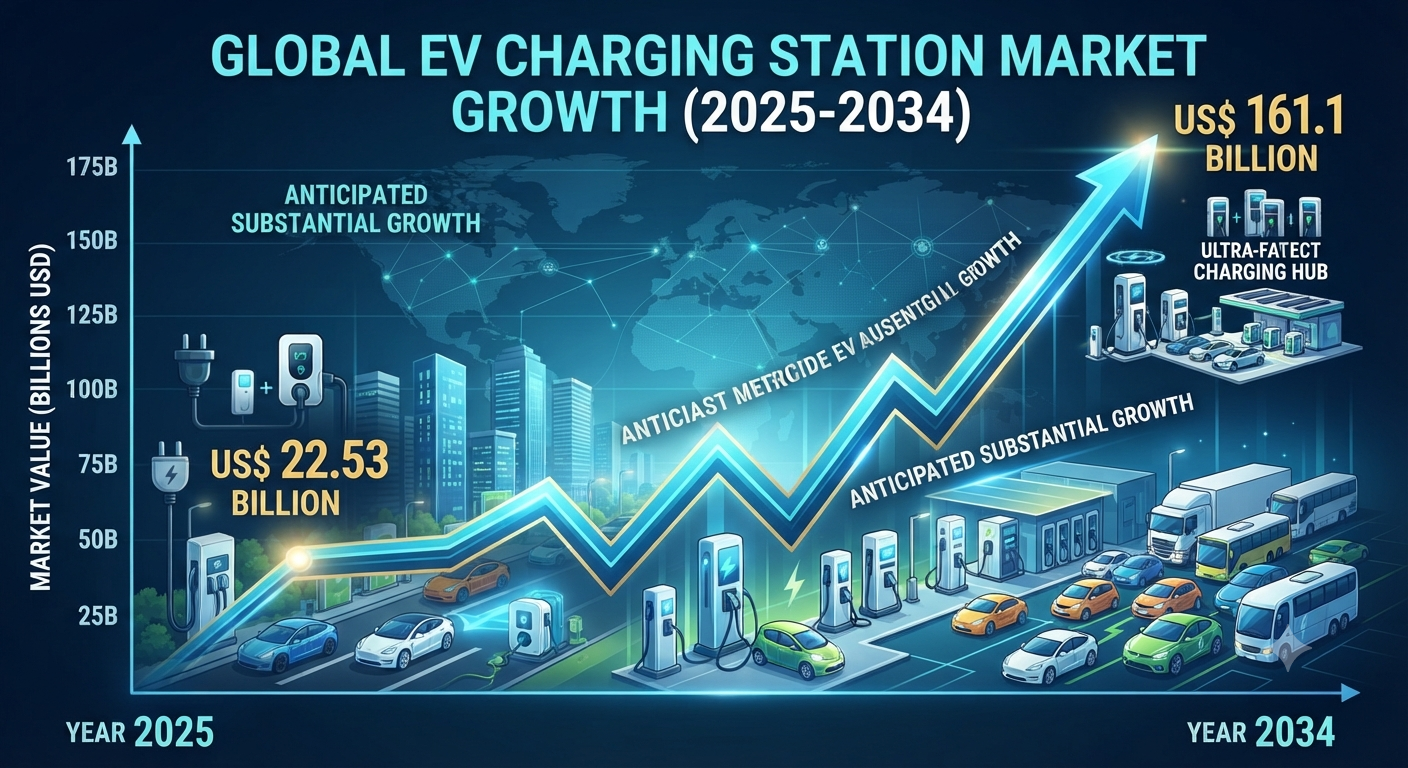
According to the latest research by Renub Research, the EV Charging Station Market is anticipated to experience substantial growth, rising from US$ 22.53 billion in 2025 to US$ 161.1 billion by 2034. The market is projected to expand at a robust Compound Annual Growth Rate (CAGR) of 24.43% from 2026 to 2034. This exponential surge is driven by a global commitment to decarbonization, aggressive government incentives, and rapid innovations in charging efficiency.
Download Free Sample Report: https://www.renub.com/request-sample-page.php?gturl=electric-vehicle-charging-station-market-p.php
The EV Charging Landscape
An EV charging station is the critical link between the electrical grid and the modern vehicle. By safely transferring power to electric buses, cars, and two-wheelers, these stations are becoming as ubiquitous as the traditional gas station. The infrastructure is broadly categorized by charging speed:
-
Level 1 & 2: Primarily used for residential and workplace settings, offering slower, cost-effective charging.
-
DC Fast Charging: High-power solutions designed for highways and commercial hubs, capable of reaching an 80% charge in minutes.
As the global fleet of electric vehicles continues to grow, the charging station market is evolving from simple plug-in points to "smart" connected systems that manage energy distribution with high-level efficiency.
Growth Drivers: Fueling the Expansion
The rapid build-out of charging infrastructure is being pushed by a "perfect storm" of consumer demand and legislative pressure.
1. The Global Shift to Electric Mobility
The primary driver remains the sheer volume of EV adoption. With over 17 million electric vehicles sold globally in 2024—representing 20% of total vehicle sales—the demand for reliable charging points has become a practical imperative. As automakers expand their electric lineups and consumers migrate away from fossil fuels, the existing infrastructure must scale rapidly to keep pace.
2. Government Policy and Financial Incentives
Governments worldwide are acting as the primary catalysts for infrastructure growth. By implementing strict emission reduction targets and providing direct subsidies for the installation of both private and public chargers, policymakers are drastically lowering the barrier to entry for operators. Initiatives like the phase-out of diesel and gasoline vehicles are ensuring that the future of transport is intrinsically linked to electrical infrastructure.
3. Technological Innovations
Advancements in technology are solving the two greatest pain points of EV ownership: recharging time and energy optimization.
-
Ultra-Fast Charging: Innovations like mass-produced high-capacity chargers (e.g., BYD’s recent 1500 kW supercharger) are redefining efficiency.
-
Smart & Connected Charging: The integration of IoT and cloud computing allows for remote monitoring, grid balancing, and mobile-app-based payments, significantly improving the user experience.
Overcoming Key Challenges
Despite the strong growth trajectory, the industry faces structural hurdles that require long-term investment:
-
High Initial Capital Expenditure: Building a robust charging network requires heavy upfront investment in electrical upgrades, land, and high-tech equipment. For small businesses, this financial burden remains a significant barrier without continued government support.
-
Range Anxiety: The scarcity of stations in rural or developing regions continues to fuel "range anxiety." Achieving market maturity requires high-level coordination between governments and private energy providers to ensure network compatibility and geographical coverage.
Regional Market Trends
-
United States: With massive private-public partnerships (such as the recent Driivz and XLR8 collaboration), the U.S. is rapidly deploying thousands of charging sites across retail and commercial corridors.
-
United Kingdom: Driven by a clear mandate to phase out internal combustion vehicles, the UK is seeing aggressive private investment—such as Duracell’s £200 million commitment to ultra-fast charging networks—to support its growing EV population.
-
India: The market is in a high-potential development phase. Focus is shifting toward electric two-wheelers and buses, with groundbreaking projects like the MegaWatt Ultra-Fast Charging Hub at Bangalore Airport setting the standard for highway mobility.
-
Saudi Arabia: Through the Saudi Electric Vehicle Infrastructure Company (EVIQ), the Kingdom is aggressively building out smart-city infrastructure. Their goal to launch 60 charging stations across major urban centers and highways by the end of 2025 demonstrates a rapid entry into the EV sector.
Market Segmentation at a Glance
| Segment | Categories |
| Charger Type | Slow Charger, Fast Charger |
| Charging Type | AC Charging, DC Charging |
| Connectivity | Non-connected, Connected (Smart) |
| Application | Commercial, Residential |
Key Industry Players
The competitive landscape is defined by companies driving the hardware and software backbone of the EV revolution:
-
Infrastructure Leaders: ABB Ltd., Siemens, Schneider Electric, and Eaton Corporation.
-
Specialized Charging Networks: ChargePoint, Inc., Blink Charging Co., and Tesla Inc.
-
Hardware Innovators: Delta Electronics, Inc. and Webasto Group.
Frequently Asked Questions (FAQs) - Renub Research Insights
1. What is the projected market size for EV Charging Stations by 2034?
Renub Research estimates the market will reach US$ 161.1 billion by 2034, up from US$ 22.53 billion in 2025.
2. What is the expected CAGR for this market?
The market is anticipated to grow at a Compound Annual Growth Rate (CAGR) of 24.43% from 2026 to 2034.
3. What are the main drivers of the EV charging station market?
The surge is driven by rapid global EV adoption, aggressive government subsidies for clean energy infrastructure, and technological leaps in charging speed and energy efficiency.
4. How does "Smart Charging" improve the industry?
Smart or "connected" charging uses IoT and cloud tech to optimize energy consumption based on grid demand, reducing costs for the operator and providing a more seamless experience for the driver.
5. What is "range anxiety," and how is it being solved?
Range anxiety is the fear of running out of power; it is being addressed through the expansion of DC fast-charging networks on highways and better mobile-app integration to locate available chargers.
6. Which region is currently the most active in building EV infrastructure?
While China leads in vehicle sales, North America and Europe are seeing massive growth due to recent private-public funding initiatives and long-term regulatory commitments to phase out fossil-fuel vehicles.
7. Why are portable EV chargers gaining importance?
Portable chargers offer fleet owners and travelers a crucial backup, providing flexibility and peace of mind in remote areas where fixed charging infrastructure is still absent.
This summary provides a foundational overview of the global EV charging station market. For detailed financial projections, specific regional data points, and in-depth competitive SWOT analyses, please refer to the full market intelligence report provided by Renub Research

 English
 Arabic
 French
 Spanish
 Portuguese
 Deutsch
 Turkish
 Dutch
Dutch
 Italiano
 Romaian
 Portuguese (Brazil)
 Greek
Greek