


BIS Certification Explained: Process, Cost & License
INTRODUCTION
BIS Certification is an essential requirement for manufacturers and importers who want to sell their products in India. Governed by the Bureau of Indian Standards (BIS), this certification ensures that products meet quality, safety, and reliability standards. Whether you are a domestic manufacturer or an importer, understanding the bis certification process india is crucial to avoid legal issues and build trust with consumers.
In this blog, we will cover everything about BIS Certification, including the certification mark, licensing, import requirements, and how to get BIS certification in India
What is BIS Certification?
BIS Certification is a quality certification issued by the Bureau of Indian Standards, the national standards body of India. It ensures that products comply with Indian safety and quality standards before they reach the market.
Products that meet the required standards are allowed to carry the bis certification mark, which acts as proof of compliance and builds consumer confidence.
Importance of BIS Certification
Getting a BIS License offers several advantages:
-
Ensures product safety and quality
-
Builds brand credibility in the market
-
Mandatory for certain products under Indian law
-
Helps in smooth import and export processes
-
Protects consumers from substandard products
For many product categories, especially electronics, appliances, and construction materials, BIS Certification is mandatory.
Types of BIS Certification Schemes
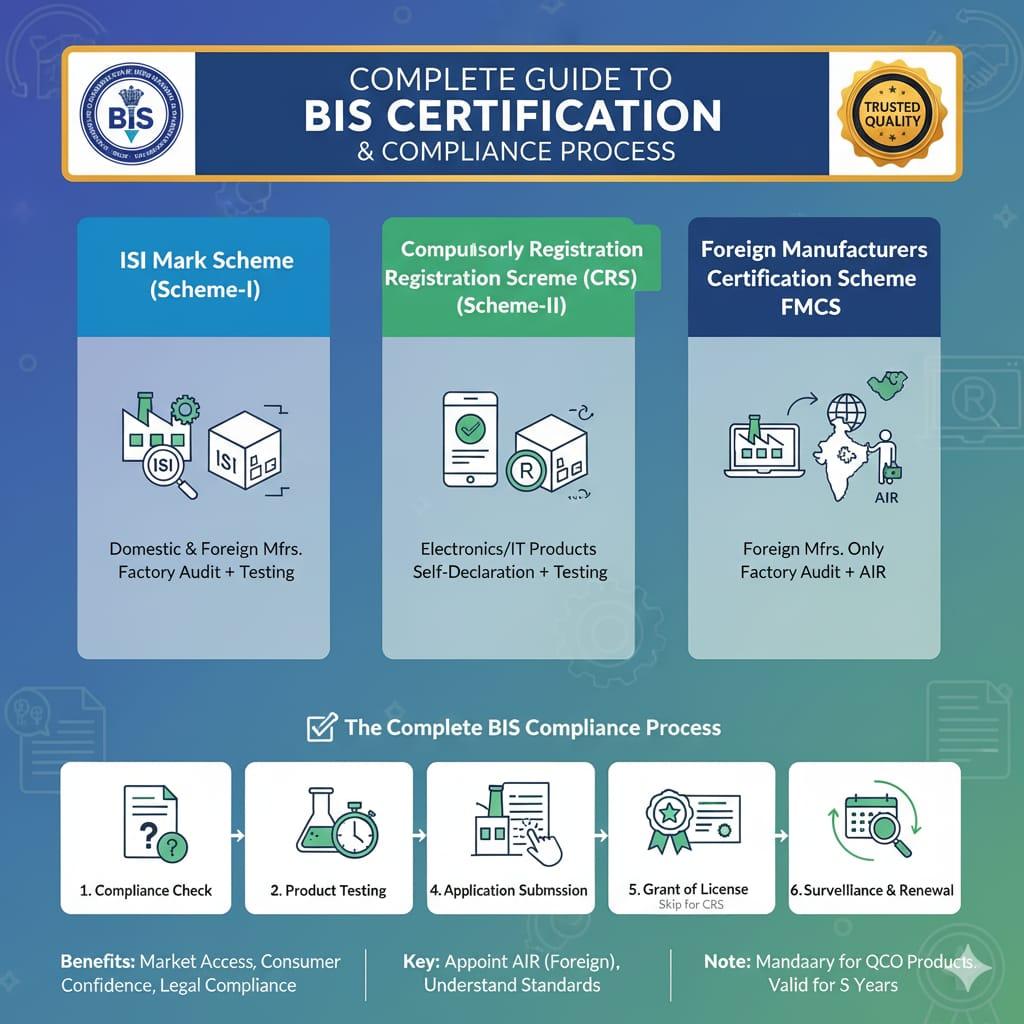
There are mainly two popular BIS certification schemes:
1. ISI Mark Scheme
This is for domestic manufacturers. Products are tested and inspected before granting the BIS License.
2. CRS (Compulsory Registration Scheme)
Applicable for electronics and IT goods. Manufacturers must register their products before selling in India.
3. FMCS (Foreign Manufacturers Certification Scheme)
This is specifically for foreign manufacturers who want to export products to India.
BIS Certification for Import
If you are importing goods into India, you must comply with BIS Certification for Import regulations. Without proper certification, your goods may be seized or rejected by customs authorities.
Key Requirements:
-
Obtain a valid BIS Import Certificate
-
Ensure product testing in BIS-approved labs
-
Label products with the BIS standard mark
-
Appoint an Authorized Indian Representative (AIR) for foreign manufacturers
Having a BIS Import License ensures smooth customs clearance and legal compliance.
BIS Certification Process India
Understanding the bis certification process india is essential to get approval without delays. Here is a step-by-step guide:
Step 1: Identify Applicable Standard
Determine the Indian Standard (IS) applicable to your product.
Step 2: Product Testing
Get your product tested in a BIS-recognized laboratory to ensure compliance.
Step 3: Application Submission
Submit the application online with required documents such as:
-
Test reports
-
Business license
-
Manufacturing details
Step 4: Factory Inspection
BIS officials may inspect the manufacturing unit to verify processes and quality control.
Step 5: Grant of BIS License
Once all requirements are met, BIS issues the license, allowing you to use the bis certification mark.
How to Get BIS Certification in India
Many businesses often ask how to get bis certification in india easily. Here are some practical tips:
-
Understand product category and applicable standards
-
Prepare all documents in advance
-
Choose a BIS-approved testing laboratory
-
Ensure your manufacturing process meets quality norms
-
Work with experienced consultants for faster approval
Following these steps can significantly reduce approval time and avoid rejection.
Documents Required for BIS Certification
To obtain a BIS License, you typically need:
-
Company registration certificate
-
Manufacturing unit details
-
Product specifications
-
Test reports from BIS-approved labs
-
Quality control documents
-
Authorization letter (for importers)
Having complete documentation ensures a smooth certification process
BIS Certification Mark
The bis certification mark (also known as the ISI mark) is a symbol of quality and safety. It is mandatory for many products and assures customers that the product meets Indian standards.
Using the mark without authorization is a punishable offense under Indian law.
Cost of BIS Certification
The cost of BIS Certification depends on several factors:
-
Product type
-
Testing fees
-
Application fees
-
Inspection charges
-
Professional consultancy fees
Although the cost may vary, investing in BIS Certification ensures long-term benefits and legal compliance.
Common Challenges in BIS Certification
Businesses often face the following challenges:
-
Lack of awareness about standards
-
Delays in testing and approvals
-
Incomplete documentation
-
Difficulty in compliance for imported goods
These challenges can be minimized by proper planning and expert guidance.
Benefits for Importers and Manufacturers
Whether you are a local manufacturer or importer, BIS Certification offers:
-
Legal permission to sell in India
-
Better market acceptance
-
Competitive advantage
-
Reduced risk of penalties
For importers, having a BIS Import Certificate is crucial for smooth operations.
Conclusion
BIS Certification is not just a regulatory requirement—it is a mark of trust, quality, and safety. Understanding the bis certification process india and following the correct steps can help businesses avoid delays and penalties.
For expert assistance and hassle-free BIS Certification services, you can rely on sunconsultants.co.in.

 English
 Arabic
 French
 Spanish
 Portuguese
 Deutsch
 Dutch
Dutch
 Italiano
 Russian
 Romaian
 Portuguese (Brazil)
 Greek
Greek