


North America Leads Food & Beverage Metal Cans Market While Asia Pacific Records Fastest Growth
Key Highlights
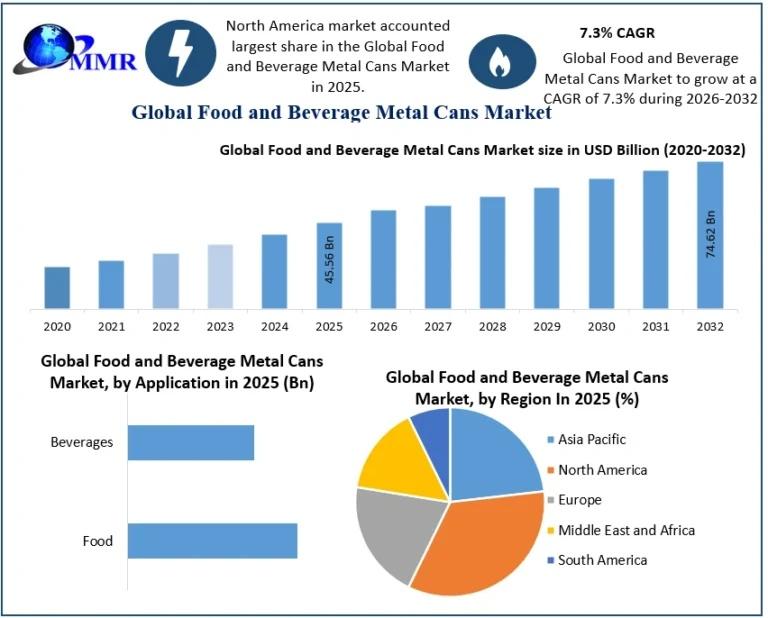
- Food & Beverage Metal Cans Market reached USD 45.56 Billion in 2025.
- Market is forecast to reach USD 74.62 Billion by 2032.
- CAGR is projected at 7.3% during 2026-2032.
- North America remained the leading regional market.
- Steel accounted for the largest raw material segment.
- Three-piece cans dominated the can type segment.
- Beverages represented the largest application category.
- Sustainable packaging and recycling initiatives continue to strengthen demand.
Why This Matters Now
Governments, food manufacturers, and consumers are accelerating the transition toward recyclable packaging. Metal cans provide long shelf life, product safety, and high recycling rates while helping brands reduce environmental impact. This shift is increasing investments in advanced can manufacturing, lightweight packaging, and sustainable coating technologies across the global packaging industry.
Market Overview
Food and beverage metal cans Market are widely used for packaging processed foods, canned vegetables, meat products, carbonated beverages, alcoholic drinks, sports beverages, and ready-to-consume products. Manufactured primarily from steel and aluminium, these containers protect products from contamination, moisture, oxygen, and physical damage throughout storage and transportation.
Rapid urbanization, changing consumer lifestyles, and growing demand for convenient packaged foods continue to increase metal can consumption worldwide. Consumers increasingly prefer packaging that combines durability, portability, product safety, and environmental sustainability.
Manufacturers are improving can performance through advanced coatings, lightweight materials, and innovative closure systems while maintaining compliance with food safety regulations.
Supply continues to benefit from expanding beverage production, rising processed food consumption, and increasing recycling infrastructure, although fluctuations in steel and aluminium prices remain a major operational challenge.
Key Trends Driving Growth
Sustainability has become the defining trend across the packaging industry. Aluminium and steel cans offer high recyclability and circular economy advantages, making them increasingly attractive alternatives to plastic packaging.
Packaging innovation continues to improve product functionality. Easy-open lids, resealable tops, lightweight structures, and advanced protective coatings enhance consumer convenience while extending product shelf life.
Manufacturers are investing in water-based coatings, UV-cured coatings, and high-solid coating technologies that improve corrosion resistance, reduce contamination risks, and strengthen food safety compliance.
Demand for ready-to-eat meals, canned beverages, frozen food products, and on-the-go consumption continues to expand packaging requirements across both developed and emerging markets.
Raw material price volatility remains a key industry challenge. Fluctuating aluminium and steel costs directly affect production economics, encouraging manufacturers to improve manufacturing efficiency and optimize material utilization.
Global trade in aluminium sheets, steel packaging materials, and finished cans continues to strengthen international supply chains while supporting regional manufacturing expansion.
Segment Insights
Dominant Segment: Steel
Steel represented the largest raw material segment in 2025 due to its strength, durability, affordability, and compatibility with food preservation. Steel cans provide excellent protection against contamination while maintaining product quality throughout extended storage periods.
Food manufacturers continue selecting steel packaging for canned vegetables, meat, seafood, and processed foods because of its structural reliability and recycling advantages.
Business impact: Steel remains the preferred material for high-volume food packaging, supporting stable demand across industrial food processing and retail distribution.
Explore detailed analysis, insights, and growth opportunities : https://www.maximizemarketresearch.com/request-sample/110312/
Fastest-Growing Segment: Beverages
The beverages segment is expected to record the fastest growth throughout the forecast period. Rising consumption of carbonated drinks, alcoholic beverages, sports drinks, and energy beverages continues increasing demand for aluminium and steel cans.
Consumers increasingly favor portable, lightweight, recyclable beverage packaging suitable for convenience retail, foodservice, and outdoor consumption.
Business impact: Beverage producers continue investing in canning capacity to improve production efficiency while meeting sustainability commitments and consumer packaging preferences.
Additional Key Sub-segments
Three-piece cans accounted for the largest share by can type due to their broad utilization across commercial food packaging applications. Their manufacturing flexibility supports multiple product categories and packaging sizes.
Two-piece cans are steadily expanding as beverage manufacturers seek lighter packaging solutions with improved production efficiency and lower material consumption.
Pressurized cans continue supporting carbonated beverages, while vacuum cans remain important for preserving food freshness and extending shelf life across processed food applications.
Regional Growth Story
North America maintained the largest market share in 2025. Strong environmental regulations, advanced recycling systems, and growing consumption of canned beverages, frozen foods, and ready-to-eat meals continue supporting regional demand. Consumer preference for recyclable packaging further strengthens investment across the can manufacturing industry.
Asia Pacific is projected to experience the fastest growth through 2032. Rapid urbanization, rising disposable incomes, expanding food processing industries, and increasing demand for packaged beverages are driving consumption across China, India, Japan, and South Korea. The region also benefits from abundant iron ore and bauxite resources supporting aluminium and steel production.
Europe continues to emphasize circular economy initiatives and sustainable packaging regulations, encouraging greater adoption of recyclable metal packaging across food and beverage manufacturers.
South America continues benefiting from increasing demand for canned food products, while the Middle East & Africa demonstrate steady market development despite continued consumer preference for freshly prepared foods.
Regional competitiveness increasingly depends on manufacturing efficiency, recycling infrastructure, raw material availability, and regulatory compliance.
Competitive Landscape
The market remains highly competitive with global packaging manufacturers investing in production capacity, lightweight technologies, and sustainable packaging innovations.
Crown Holdings, Inc., Ball Corporation, and Silgan Holdings, Inc. continue leading through large-scale manufacturing capabilities, extensive global distribution networks, and continuous product innovation. Their investments strengthen relationships with multinational food and beverage companies while improving operational efficiency.
CCL Industries, Independent Can Company, Huber Packaging Group GmbH, Mauser Packaging Solution LLC, Muller und Bauer GmbH, Masilly Holdings S.A.S., Toyo Seikan Group Holding Ltd., and CPMC Holdings Ltd. compete by expanding regional manufacturing capabilities and offering customized packaging solutions across multiple food and beverage categories.
Competitive differentiation increasingly depends on recyclable materials, lightweight can designs, advanced coatings, and manufacturing efficiency rather than production volume alone.
Recent Developments
- Manufacturers continue investing in lightweight metal can technologies to reduce material consumption while maintaining structural performance.
- Packaging companies are expanding adoption of water-based, UV-cured, and high-solid coating technologies to improve food safety and corrosion resistance.
- Industry participants continue increasing production of easy-open and resealable can designs to enhance consumer convenience.
- Growing investments in recycling infrastructure and sustainable manufacturing processes continue strengthening the environmental profile of aluminium and steel packaging.
Future Outlook
Companies that combine recyclable packaging innovation, lightweight manufacturing technologies, and resilient aluminium and steel supply chains will secure the strongest competitive position as global demand for sustainable food and beverage packaging continues to accelerate.
Explore More: Visit our website for Additional reports :
Macadamia market https://www.maximizemarketresearch.com/market-report/macadamia-market/217520/
Hot Dog Market https://www.maximizemarketresearch.com/market-report/hot-dog-market/194027/
About Maximize Market Research
Maximize Market Research Pvt. Ltd. (MMR) is a global market research and consulting company that provides reliable, data-focused, and practical business insights. The firm serves a wide range of industries, including healthcare, pharmaceuticals, technology, automotive, electronics, chemicals, personal care, and consumer goods. Through market forecasts, competitive analysis, strategic consulting, and industry impact assessments, MMR helps organizations understand changing market conditions, identify growth opportunities, and make informed business decisions for long-term success.
Contact Us :
2nd Floor, Navale IT Park Phase 3
Pune Banglore Highway, Narhe
Pune, Maharashtra 411041, India
+91 9607365656
[email protected]

 Arabic
 French
 Spanish
 Portuguese
 Deutsch
 Turkish
 Dutch
Dutch
 Italiano
 Russian
 Romaian
 Portuguese (Brazil)
 Greek
Greek