


Why Health and Safety Are Essential to Modern Manufacturing Success
Why Health and Safety Are Essential to Modern Manufacturing Success
Manufacturing facilities operate in fast moving environments where employees work alongside complex machinery, industrial equipment, raw materials, and production processes every day. These conditions create numerous workplace risks that require careful planning and effective management. As manufacturing operations continue to expand and production expectations grow, organizations increasingly understand that workplace health and safety is far more than a regulatory obligation it is a key driver of business performance.
A comprehensive safety program enables manufacturers to prevent workplace incidents, safeguard their workforce, improve operational reliability, and support uninterrupted production. Companies that make safety a core business priority often benefit from greater employee commitment, fewer operational disruptions, and more consistent manufacturing performance.
What Is Health and Safety in Manufacturing?
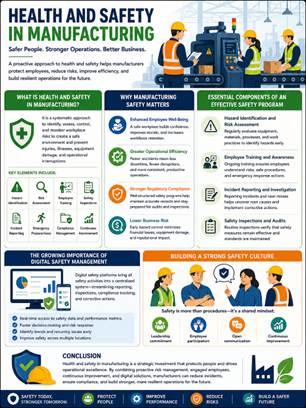
Health and safety in manufacturing is a structured process for recognizing workplace hazards, evaluating potential risks, implementing preventive measures, and continuously monitoring working conditions. Its primary objective is to provide employees with a safe environment while reducing the possibility of injuries, occupational illnesses, equipment failures, and production interruptions.
A comprehensive manufacturing health and safety program generally includes:
- Hazard identification
- Risk assessment
- Employee training
- Workplace safety inspections
- Incident reporting
- Emergency response planning
- Compliance management
- Continuous safety improvement
Instead of responding only after an incident has occurred, effective safety programs focus on identifying and eliminating potential risks before they develop into serious workplace events.
Why Manufacturing Safety Matters
The impact of workplace accidents reaches well beyond employee injuries. Incidents can interrupt production schedules, damage valuable equipment, increase operating expenses, attract regulatory attention, and negatively affect an organization's reputation.
Implementing a proactive approach to workplace safety provides several important advantages.
Enhanced Employee Well Being
Employees are more confident and productive when they know appropriate safety measures are consistently followed. A safe work environment also contributes to higher job satisfaction, stronger morale, and improved employee retention.
Greater Operational Efficiency
Fewer workplace incidents mean fewer production delays, equipment shutdowns, investigations, and unexpected interruptions. As a result, manufacturing processes remain more stable, efficient, and productive.
Stronger Regulatory Compliance
Manufacturing organizations must comply with numerous workplace safety regulations and standards. An organized safety program helps maintain accurate documentation, supports audit preparedness, and demonstrates ongoing compliance with regulatory requirements.
Lower Business Risk
Identifying hazards early and implementing appropriate controls significantly reduces the likelihood of costly workplace incidents, operational downtime, and financial losses.
Essential Elements of an Effective Manufacturing Safety Program
Hazard Identification and Risk Assessment
Creating a safer workplace begins with understanding where potential dangers exist. Regular assessments of machinery, production activities, materials, and work practices allow organizations to recognize hazards early and implement appropriate controls before incidents occur.
Employee Training and Safety Awareness
Even the most carefully developed safety procedures have limited value if employees are unfamiliar with them. Continuous training helps workers understand workplace hazards, follow safe operating practices, and respond effectively during emergency situations.
Incident Reporting and Investigation
Documenting workplace incidents, near misses, and unsafe conditions provides valuable information for improving safety performance. Investigating these events helps organizations determine their underlying causes and implement corrective measures that reduce the likelihood of future occurrences.
Safety Inspections and Audits
Routine inspections and periodic audits help confirm that existing safety measures remain effective. They also ensure workplace conditions continue to meet internal safety expectations while identifying opportunities for further improvement.
The Increasing Role of Digital Safety Management
Many manufacturing organizations are replacing traditional paper based systems and spreadsheets with digital safety management solutions. These platforms centralize safety information, making it easier to manage inspections, incident reporting, compliance activities, corrective actions, and overall safety performance.
Access to real time safety data enables organizations to respond more quickly to emerging risks, monitor performance across multiple locations, identify recurring issues, and make informed decisions that strengthen workplace safety over time.
Developing a Positive Safety Culture
Effective technology and documented procedures are important, but they are only part of the solution. Sustainable workplace safety depends on creating an organizational culture where safety is integrated into everyday operations and decision making.
Strong leadership, active employee involvement, open communication, and an ongoing commitment to improvement all help build a workplace where safety becomes a shared responsibility. When employees actively participate in identifying hazards and following established procedures, organizations create a stronger foundation for continuous improvement and long term success.
Conclusion
Health and safety in manufacturing has become an essential business function that supports both employee protection and operational performance. By integrating effective risk management practices, employee engagement, continuous improvement, and digital safety management, manufacturers can establish safer workplaces while improving productivity and long term operational resilience.
Organizations that take a proactive approach to workplace safety are better equipped to minimize incidents, maintain regulatory compliance, strengthen operational stability, and prepare their manufacturing operations for future challenges.
Book a free demo @ https://toolkitx.com/blogsdetails.aspx?title=health-and-safety-in-manufacturing
Browse More

 English
 Arabic
 French
 Spanish
 Portuguese
 Deutsch
 Turkish
 Dutch
Dutch
 Italiano
 Romaian
 Portuguese (Brazil)
 Greek
Greek