


Why Process Safety Management Matters in High Risk Industries
Why Process Safety Management Matters in High Risk Industries
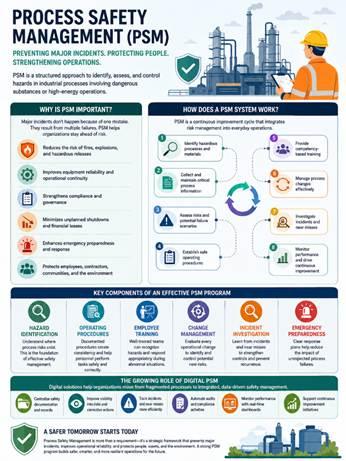
Industries that work with hazardous chemicals, combustible materials, high pressure equipment, and complex manufacturing systems face risks that extend far beyond routine workplace incidents. A single process failure can trigger fires, explosions, toxic emissions, equipment damage, production interruptions, and serious consequences for both people and the environment.
To reduce the likelihood of these large scale events, organizations rely on Process Safety Management (PSM). Unlike traditional workplace safety programs that primarily focus on preventing personal injuries, PSM is dedicated to controlling process related hazards that have the potential to cause catastrophic incidents affecting employees, facilities, nearby communities, and the environment.
What Is Process Safety Management (PSM)?
Process Safety Management is a comprehensive framework used to recognize, assess, and control hazards associated with industrial processes involving hazardous substances or high energy operations.
Rather than relying on a single safety measure, PSM brings together people, operational procedures, engineering controls, technology, and management practices to reduce process related risks. Its objective is not only to prevent immediate incidents but also to establish long term systems that improve operational consistency, resilience, and reliability.
For industries such as chemical processing, oil and gas, power generation, and other heavy industrial sectors, Process Safety Management has become an essential part of maintaining safe and dependable operations.
Why Is Process Safety Management Important?
Serious industrial accidents are rarely caused by one isolated error. More often, they result from a series of weaknesses that align over time. Process Safety Management helps organizations detect these weaknesses early, allowing corrective actions to be taken before they escalate into major incidents.
A well established PSM program provides several important benefits:
- Lowers the risk of fires, explosions, and hazardous material releases
- Improves equipment performance and operational reliability
- Supports stronger regulatory compliance and organizational governance
- Reduces unexpected downtime and associated financial impacts
- Strengthens emergency response planning and preparedness
- Safeguards employees, contractors, surrounding communities, and company assets
By taking a preventive approach to process risk, organizations can enhance both operational safety and long term business performance.
How Does a Process Safety Management System Work?
A Process Safety Management system functions as an ongoing cycle of risk management that integrates safety into daily industrial operations. Instead of being a one time initiative, it continuously evaluates and improves process safety throughout the lifecycle of operations.
The typical process includes:
- Identifying hazardous processes and materials
- Maintaining accurate and up to date process information
- Evaluating potential hazards and failure scenarios
- Developing standardized operating procedures
- Delivering role specific safety training
- Reviewing and controlling operational changes
- Investigating incidents and near miss events
- Measuring performance and implementing continual improvements
Following this structured process enables organizations to manage risks proactively while maintaining safer and more reliable operations.
Essential Elements of a Successful Process Safety Management Program
An effective Process Safety Management program is supported by several key components that work together to strengthen overall safety performance.
Hazard Identification
Recognizing potential process hazards is the first step in reducing operational risk. Understanding where vulnerabilities exist allows organizations to implement appropriate preventive measures before problems arise.
Operating Procedures
Clearly documented operating procedures provide employees with consistent guidance for performing tasks safely and correctly. Standardized instructions also help reduce operational errors across the organization.
Employee Training
Employees who receive appropriate training are better prepared to recognize process hazards, follow established procedures, and respond effectively when abnormal operating conditions occur.
Change Management
Any modification to equipment, processes, materials, or operating methods can introduce new risks. Reviewing and evaluating changes before implementation helps prevent unintended safety issues.
Incident Investigation
Examining incidents and near misses provides valuable insights into underlying causes. Applying these lessons helps organizations strengthen existing controls and reduce the likelihood of similar events in the future.
Emergency Preparedness
Well developed emergency response plans enable organizations to react quickly and effectively when unexpected process failures occur, helping minimize their overall impact.
The Expanding Role of Digital Process Safety Management
As industrial operations become more advanced and interconnected, many organizations are embracing digital technologies to improve Process Safety Management.
Digital PSM solutions allow organizations to:
- Store safety documents and records within a centralized system
- Gain better visibility into process hazards and corrective actions
- Record and manage incidents and near misses more efficiently
- Streamline audits and compliance related activities
- Monitor safety performance using real time dashboards
- Support continuous improvement through better data management
Moving from isolated spreadsheets and disconnected systems to an integrated digital platform enables organizations to make more informed decisions while improving consistency, efficiency, and overall process safety.
Conclusion
Process Safety Management is much more than a compliance obligation. It provides organizations with a structured approach to preventing major process related incidents while improving operational reliability and protecting people, facilities, and the environment.
As industrial operations continue to grow in complexity, implementing a robust PSM framework alongside digital safety solutions can help organizations strengthen risk management, improve operational resilience, and build safer, more efficient workplaces for the future.
Book a free demo @ https://toolkitx.com/blogsdetails.aspx?title=what-is-process-safety-management
Browse More
https://toolkitx.com/blogsdetails.aspx?title=loto-failures-real-industrial-incidents
https://toolkitx.com/blogsdetails.aspx?title=job-hazard-analysis-vs-task-risk-assessment

 English
 Arabic
 French
 Portuguese
 Deutsch
 Turkish
 Dutch
Dutch
 Italiano
 Russian
 Romaian
 Portuguese (Brazil)
 Greek
Greek