


A Practical Guide to RIDDOR Reporting in the Workplace
A Practical Guide to RIDDOR Reporting in the Workplace
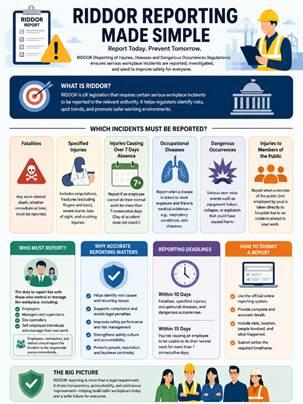
Even the most comprehensive health and safety systems cannot completely eliminate workplace risks. Despite careful planning, training, and preventive controls, accidents, work related illnesses, and hazardous incidents can still occur. When serious workplace events happen, UK law requires certain incidents to be officially reported under the RIDDOR reporting framework.
The reporting process serves an important purpose beyond legal compliance. It creates an official record of significant workplace incidents, enabling organisations and regulatory authorities to understand what occurred, investigate contributing factors, and identify practical ways to reduce similar risks in the future. Reporting major injuries, occupational diseases, and dangerous occurrences also helps improve health and safety standards across different industries.
What Is RIDDOR Designed to Achieve?
RIDDOR, short for the Reporting of Injuries, Diseases and Dangerous Occurrences Regulations, sets out the legal requirements for reporting particular workplace incidents. The regulations clearly define which events must be reported and specify the authority responsible for receiving those reports. In most cases, reports are submitted to the Health and Safety Executive (HSE), although some workplaces are regulated by local authorities instead.
The duty to report does not apply to every worker. It is the responsibility of those who manage or control workplace activities and premises. This typically includes employers, supervisors, managers, site operators, and self employed individuals who oversee their own work.
While complying with legislation is a key requirement, the broader purpose of RIDDOR is to support long term improvements in workplace safety. Information gathered through incident reports allows regulators to identify recurring risks, monitor industry patterns, and encourage safer working practices. Sectors with higher operational risks, including construction, manufacturing, facilities management, and oil and gas, benefit particularly from this approach because it helps drive continuous safety improvements.
Why Accurate RIDDOR Reporting Is Important
Submitting accurate reports provides value that extends well beyond meeting statutory obligations. Well maintained incident records give organisations a clearer understanding of their overall safety performance. Reviewing reported incidents helps identify repeated issues, uncover root causes, and implement preventive measures before similar events happen again.
Accurate reporting is also essential for maintaining compliance with workplace safety legislation. Failing to report incidents that meet RIDDOR criteria can lead to investigations by regulators, enforcement action, financial penalties, and damage to an organisation's reputation. Conversely, meeting reporting responsibilities demonstrates accountability, openness, and a genuine commitment to protecting employees and others affected by workplace activities.
Regular reporting also encourages a stronger safety culture. Every reported incident creates an opportunity to assess existing procedures, revise risk assessments, and improve employee training. By learning from previous incidents, organisations can take a more proactive approach to risk management rather than responding only after accidents have taken place.
Which Workplace Incidents Require Reporting?
Not every accident in the workplace falls under RIDDOR. The regulations apply only to specific categories of serious incidents that meet defined reporting criteria.
Any work related fatality must be reported, regardless of whether the death occurs immediately or at a later stage, provided there is a connection to workplace activities.
Certain serious injuries also require reporting. These include major injuries such as amputations, fractures excluding fingers and toes, significant burns, permanent loss of sight, and injuries resulting from crushing incidents.
A report is also necessary when an employee is unable to carry out their normal work duties for more than seven consecutive days because of a workplace injury. The day on which the accident occurred is not included when calculating this period.
Some occupational diseases must also be reported where medical evidence confirms that the illness has been caused or made worse by work related exposure. Common examples include occupational skin disorders and respiratory conditions.
Dangerous occurrences are another reportable category, even when nobody is injured. These serious near miss events include situations such as equipment malfunctions, structural failures, or explosions that had the potential to cause significant harm.
Reporting is also required when a member of the public who is not employed by the organisation is taken directly to hospital following an incident connected with workplace activities.
Who Is Responsible for Reporting?
The obligation to submit a RIDDOR report lies with the person or organisation responsible for managing the workplace. In most cases, this responsibility belongs to the employer or a manager with designated health and safety duties. Self employed individuals who control their own work activities also have the responsibility to report incidents that meet the reporting criteria.
Employees, contractors, and visitors are generally not responsible for filing official RIDDOR reports. However, they should promptly inform the appropriate person whenever a reportable incident occurs so the necessary reporting process can be completed accurately and within the required timeframe.
Reporting Timeframes and Submission Process
Complying with reporting deadlines is an important part of meeting RIDDOR requirements. Fatalities, specified injuries, occupational diseases, and dangerous occurrences should normally be reported as soon as reasonably possible, typically within ten days. Where a workplace injury prevents an employee from carrying out their normal duties for more than seven consecutive days, the report should usually be submitted within fifteen days.
Most organisations complete the reporting process through the official online reporting system. Including complete and accurate information such as the date, location, people involved, and a clear description of the incident helps ensure the report supports both regulatory investigations and internal safety reviews while contributing to future risk reduction.
Conclusion
RIDDOR reporting is much more than a legal requirement. It plays a vital role in improving workplace health and safety by encouraging transparency, accountability, and continuous learning. When organisations understand which incidents must be reported, recognise who is responsible, and submit accurate reports within the required deadlines, they not only remain compliant with legal obligations but also contribute to creating safer workplaces for employees, contractors, visitors, and the wider public.
Book a Free Demo @ https://toolkitx.com/blogsdetails.aspx?title=RIDDOR-Reporting:-What-Must-Be-Reported-and-How

 English
 Arabic
 Spanish
 Portuguese
 Deutsch
 Turkish
 Dutch
Dutch
 Italiano
 Russian
 Romaian
 Portuguese (Brazil)
 Greek
Greek