


Continuous Dehydration For Unmanned Remote Sites
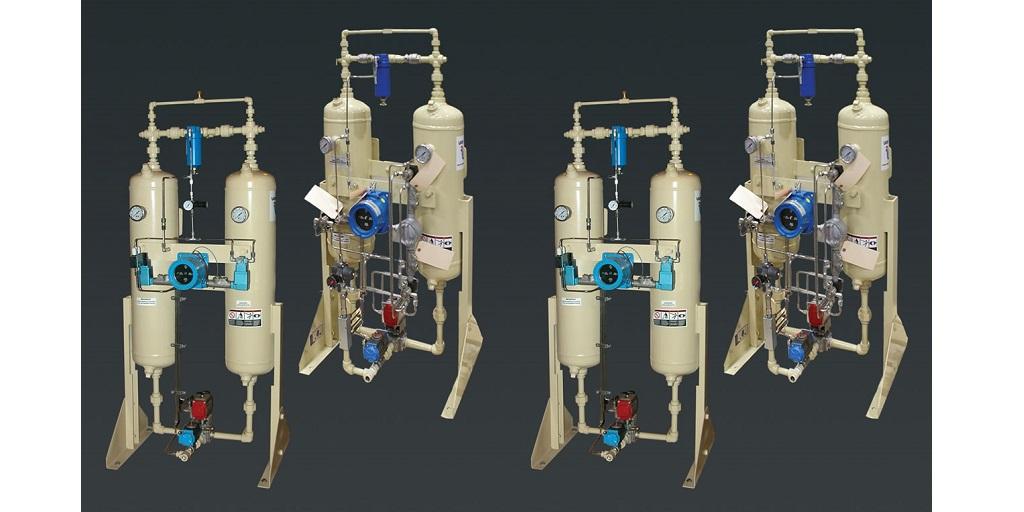
For remote, unmanned gas operations, equipment reliability is paramount over performance. The natural gas dehydrator is a critical component that protects instruments, valves, and controls without requiring daily supervision.
Remote wellheads, compressor skids, and metering stations often run for weeks or months without hands-on attention. Dehydration systems in these settings require continuous, predictable function with minimal failure points.
Why Continuous Dehydration Matters in Remote Operations
Natural gas moisture causes escalating problems: condensation, ice formation in cold weather, and accelerated control line corrosion. Instrument response becomes inconsistent. None of these issues announce themselves immediately, which is why dehydration failures at unmanned sites are often discovered only after downstream problems appear.
Properly designed natural gas dehydration prevents operational issues. Consistent moisture removal maintains gas quality, stabilizing instrument and actuator performance against ambient changes.
Why Automatic Tower Switching is Critical
Regenerative dehydrators typically have two desiccant towers that alternate: one is drying the gas while the other is being regenerated. For places that are way out there and unstaffed, this tower swap needs to happen automatically. We can't count on someone being there to flip the switch or on an operator scheduling it.
For unmanned remote sites, automatic tower switching is essential to ensure continuous dehydration. This automation guarantees:
- Drying capacity is continuously maintained.
- The desiccant media never becomes irreversibly saturated.
- Gas flow is uninterrupted during the regeneration process.
- Moisture breakthrough is prevented without the need for manual checks or alarms.
Automatic switching serves to safeguard against moisture contamination, which might otherwise result from an undetected single valve malfunction or a delayed regeneration cycle. This basic automation is vital for unattended sites.
What Happens When Regeneration Fails Unnoticed
Dehydration has a silent partner in regeneration. Its success often goes unremarked, but its failure initiates a gradual decline in performance.
Incomplete desiccant regeneration leaves residual moisture, reducing drying efficiency. This raises the dew point, potentially exceeding acceptable limits, especially in cold or high-pressure conditions.
Running remote, unstaffed sites presents specific problems: unreliable data, performance issues (e.g., slow or stuck valves), and accelerated equipment wear (e.g., freezing from temperature swings, premature control tubing rust).
People often miss the dehydrator as the culprit because these symptoms show up later in the system. Moisture damage is often realized too late.
This is why regeneration reliability is as important as drying performance. A natural gas dehydrator designed for remote service must regenerate consistently without external prompts.
Why Simple Control Logic Often Outperforms Complex Automation
It is tempting to assume that more automation equals better reliability. In practice, the opposite is often true at remote and hazardous sites.
Simple control logic—timers, pressure-based switching, and mechanical sequencing—tends to outperform complex electronic systems in these environments. Fewer sensors and control layers reduce calibration issues and failure points. Simpler systems continue to operate despite power fluctuations or communication drops.
For unmanned installations, the goal is not real-time optimization. It is stability over long periods. Straightforward sequencing enables the natural gas dehydrator to perform its task without relying on external data, network connectivity, or operator adjustments.
Reliability is About Predictability, Not Intervention
Remote gas infrastructure relies on equipment that operates consistently day to day, regardless of weather, load changes, or site access limitations. Continuous dehydration supports that consistency by removing one of the most common sources of instability: moisture.
When dehydration systems are designed with automatic switching, reliable regeneration, and simple controls, they enable unattended operation rather than complicate it. The result is fewer site visits, fewer emergency repairs, and fewer process interruptions caused by preventable moisture issues.
For operators managing remote or unmanned assets, working with suppliers who understand these realities matters. Air Vacuum & Process, Inc. supports gas dehydration solutions built for continuous operation in demanding environments.
For more information about Silent Air Compressors and Compressed Air Dryer System Please visit: Air & Vacuum Process Inc.

 English
 Arabic
 French
 Spanish
 Portuguese
 Turkish
 Dutch
Dutch
 Italiano
 Russian
 Romaian
 Portuguese (Brazil)
 Greek
Greek