


Industrial Rigging Dollies for House Moves, Transformer Relocations, and Heavy Industrial Work
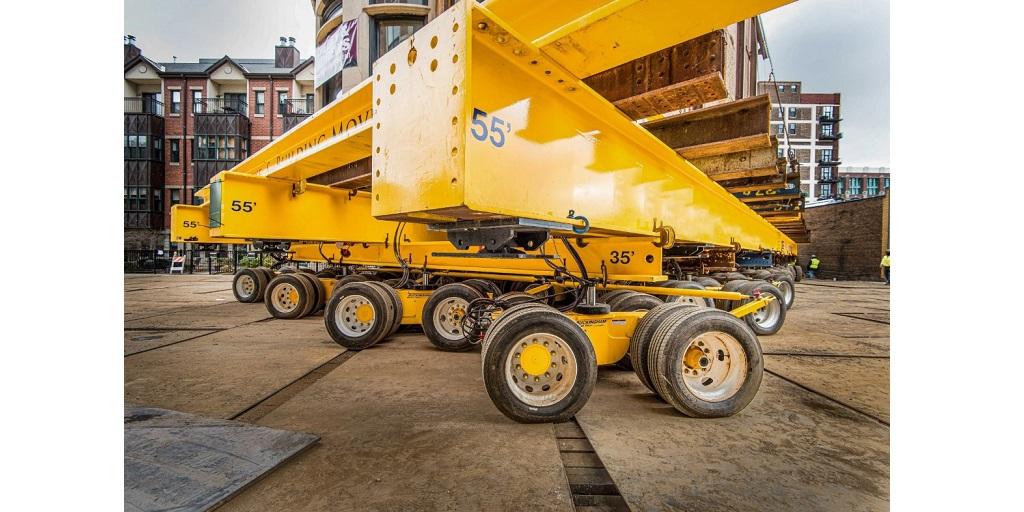
Some loads simply can't be craned onto a flatbed and driven away. A two-story farmhouse being relocated from a widening highway. A 60-ton power transformer that has to be walked from the substation gate to its concrete pad. A turbine housing that needs to thread between two existing buildings with inches to spare. For jobs like these, industrial machine rigging dollies are the single most important piece of equipment on the site, and the difference between a clean move and a catastrophe usually comes down to having the right dolly configuration under the load.
What rigging dollies actually do
An industrial rigging dolly is a heavy steel chassis riding on large-diameter, high-capacity wheels, designed to carry extreme point loads at ground level. Unlike trailers, which require a truck and a road, dollies operate as a system of independent units placed strategically beneath a load. They distribute weight across many axles, lower ground pressure to protect surfaces, and — critically — allow the load to be driven, steered, and set in places no over-the-road vehicle can reach.
The core insight of modern rigging is modularity. Rather than building one massive transporter to handle a specific weight, riggers assemble a dolly train from specialized units, each doing one job well. Buckingham Equipment's system is a good example of how this plays out in the field.
The specialists in a typical dolly train
Power dollies provide the muscle. These are the self-propelled, steerable units that supply tractive effort and directional control for the entire train. When a house leaves its foundation, the power dolly is what's actually pushing it down the road. It interfaces with hydraulic power units to lift, level, and stabilize the load, essential when you're raising a structure off cribbing or compensating for a sloped driveway. On a large move, riggers often deploy multiple power dollies as "powered corners," coordinating them to steer a load that's longer than a semi-trailer.
Coaster dollies do the opposite job: they don't drive, they just carry. Parking a coaster under the load adds axle count, which drops the pounds-per-axle number dramatically. This matters enormously when rolling across a wooden bridge deck, a warehouse floor rated for forklift traffic, or soft yard gravel that would otherwise rut under concentrated weight.
Crab steer dollies solve the geometry problem. Most loads want to travel in one direction, but real jobsites demand lateral and diagonal repositioning: threading a transformer through a double-wide doorway, sliding a modular building alongside a pipe rack, or nudging a generator sideways to line up with its anchor bolts. Crab steering uses hydraulic power steering to move the dolly's wheels independently, letting the whole unit shift sideways without rotating. A 45-ton crab-steer unit with a 16-inch stroke lift cylinder gives riggers the fine positioning control that hand-pinching with pry bars simply can't match.
Air-ride crab steer dollies add shock isolation to that same maneuverability. For vibration-sensitive cargo, such as historic masonry that will crack at the wrong frequency, medical imaging equipment, data center racks, or museum pieces, air suspension between the wheels and the load deck absorbs the bumps that would otherwise translate directly into the structure. These are the dollies you see under relocated churches and under precision industrial equipment crossing uneven yards.
Why the system matters more than any single dolly
The reason serious rigging outfits invest in modular dolly systems is that the job requirements change mid-move. A house that rolls easily down a straight road may need four coasters to cross a parking lot, then a crab-steer unit to line up with the new foundation. A transformer leaving a rail siding might need power dollies for the long haul and air-ride units for the final approach to the pad.
Matching the right dolly to each phase of the move is how crews protect multimillion-dollar assets, stay on schedule, and walk off the site with the load sitting exactly where the engineer drew it. For your industrial moving equipment needs, visit Buckingham Structural Moving Equipment today!
For more information about House Jack Lift and Shoring Posts Please visit: Buckingham Structural Moving Equipment, LLC.

 English
 Arabic
 French
 Spanish
 Portuguese
 Deutsch
 Turkish
 Dutch
Dutch
 Italiano
 Russian
 Romaian
 Portuguese (Brazil)