


Mems Speakers Market: The Silicon Revolution in Personal Audio
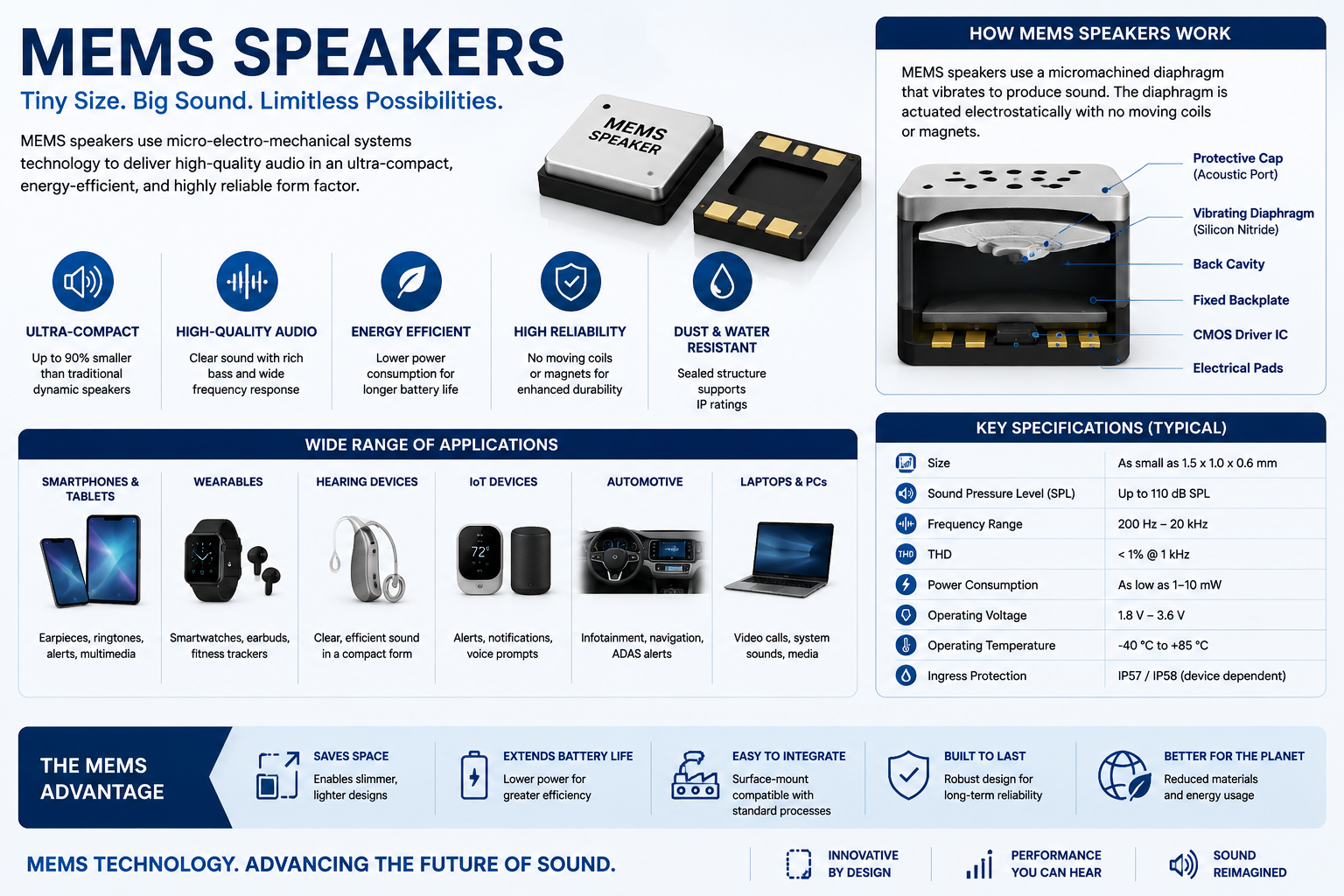
The global Mems Speakers Market is currently undergoing a radical transformation as the electronics industry moves away from century-old balanced armature and dynamic driver technologies. For decades, sound reproduction relied on magnets, copper coils, and paper or plastic membranes. However, the advent of Micro-Electromechanical Systems (MEMS) has allowed engineers to manufacture speakers directly on silicon wafers. This shift is not merely a change in materials; it represents a move toward semiconductor-style scaling, where sound components benefit from the same precision, consistency, and miniaturization that have driven the microprocessor industry for decades.
Market Overview and Introduction
The introduction of micro electromechanical speakers has fundamentally changed the design constraints for hardware engineers. Unlike traditional drivers that require significant manual assembly and suffer from high unit-to-unit variance, MEMS audio technology allows for high-volume automated production with near-perfect phase matching. This level of precision is critical for modern audio applications, such as Active Noise Cancellation (ANC) and spatial audio, where the timing and consistency of the sound wave are paramount. As a result, the market is seeing rapid adoption across TWS (True Wireless Stereo) earbuds, hearing aids, and wearable devices.
Key Growth Drivers
Several factors are propelling the industry forward, most notably the explosion of the TWS earbud sector. Consumers are demanding smaller, lighter, and more feature-rich audio devices, which puts a premium on internal space. Because MEMS components are significantly thinner and lighter than their traditional counterparts, they allow manufacturers to include larger batteries or additional sensors. Furthermore, the push for high-resolution audio is a major driver; the inherent stiffness and low mass of silicon membranes allow for faster transient response and extended high-frequency performance, reaching well into the ultrasonic range.
Consumer Behavior and E-commerce Influence
Consumer purchasing habits have shifted toward a "specs-first" approach, largely driven by the transparency of e-commerce platforms. Buyers today are more likely to research the internal components of their electronics, looking for terms like "hi-res audio" and "all-silicon sound." This behavioral shift has forced manufacturers to prioritize component branding, often highlighting the use of miniature speaker devices in their marketing copy on Amazon, Alibaba, and direct-to-consumer websites. The ease of online comparison has shortened the product lifecycle, necessitating the rapid innovation cycles that silicon speakers provide.
Regional Insights and Preferences
North America and Europe currently lead the market in terms of high-end consumer electronics adoption, with a strong preference for premium audio experiences. However, the Asia-Pacific region is the manufacturing powerhouse, with Taiwan, China, and South Korea housing the foundries and assembly lines for silicon speakers. In these regions, there is a burgeoning market for "smart wearables" and augmented reality (AR) glasses, both of which rely heavily on compact sound modules to provide immersive audio without adding bulk to the frames.
Technological Innovations and Emerging Trends
Innovation in this space is moving toward "multi-way" silicon systems. Just as high-end home speakers use woofers and tweeters, modern earbuds are beginning to use a dynamic driver for bass and a MEMS unit for the mids and highs. This hybrid approach leverages the strengths of both technologies. Additionally, we are seeing the emergence of "Sound-on-Chip" designs, where the amplifier, DSP (Digital Signal Processing), and speaker are integrated into a single package, drastically reducing power consumption and simplifying the electrical path.
Sustainability and Eco-friendly Practices
Sustainability is becoming a core focus for semiconductor-based audio. Traditional speakers require rare earth magnets and significant amounts of copper, both of which have high environmental extraction costs. In contrast, silicon is abundant, and the manufacturing process for MEMS is highly efficient with minimal waste. Furthermore, the reduced power consumption of these devices leads to longer battery life in consumer electronics, reducing the frequency of charging cycles and extending the overall lifespan of the battery, which is often the first component to fail in modern gadgets.
Challenges, Competition, and Risks
Despite the advantages, the market faces challenges, particularly in the reproduction of low-frequency "bass" notes. Due to their small size and limited displacement, single silicon membranes struggle to move the volume of air required for deep bass. This necessitates hybrid designs or complex multi-membrane arrays, which can increase costs. Competition also remains fierce from established balanced armature manufacturers who are optimizing their own processes to compete on size and price.
Future Outlook and Investment Opportunities
The future outlook for the sector is exceptionally bright as AR and VR (Virtual Reality) move toward the mainstream. These technologies require extremely lightweight, high-fidelity audio solutions that can be integrated into slim head-mounted displays. Investment opportunities are particularly strong in the medical field, as the next generation of hearing aids moves toward invisible, high-performance silicon-based sound. As the manufacturing yields improve and costs drop, we expect to see these components move from premium "pro" models into mid-range consumer electronics.

 English
 Arabic
 French
 Spanish
 Portuguese
 Deutsch
 Turkish
 Dutch
Dutch
 Italiano
 Russian
 Romaian
 Portuguese (Brazil)