


Hardware-in-the-Loop Simulation and Validation
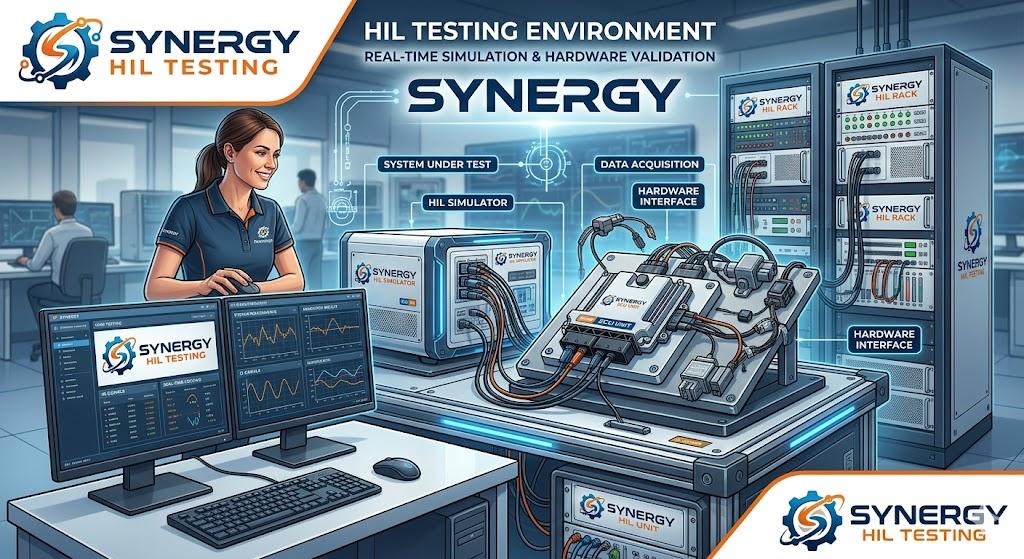
Hardware-in-the-Loop (HIL) Testing is an advanced testing technique used to validate and verify embedded systems, control algorithms, and electronic control units (ECUs) in a simulated real-time environment. It allows engineers to test hardware components without requiring the complete physical system, making product development faster, safer, and more cost-effective. HIL testing plays a critical role in industries such as automotive, aerospace, industrial automation, robotics, renewable energy, and medical devices.
In modern engineering systems, embedded controllers are responsible for managing complex operations. These controllers must function accurately under different operating conditions. Traditional testing methods often require physical prototypes, which can be expensive and time-consuming. HIL testing overcomes these challenges by simulating real-world conditions through software models while connecting actual hardware components for validation.
The HIL testing process involves integrating a real controller or embedded hardware with a virtual simulation model of the system being controlled. The simulation runs in real time and mimics actual operating conditions, enabling the controller to respond as if it were connected to a real machine or vehicle. This approach helps engineers identify software bugs, communication issues, hardware failures, and performance limitations before final deployment.
One of the major advantages of HIL testing is improved safety. Testing critical systems directly on physical equipment may involve risks, especially in industries such as automotive or aerospace. For example, testing braking systems, engine controllers, or autonomous driving features on real vehicles can be dangerous during early development stages. HIL testing provides a safe environment where engineers can simulate extreme conditions, fault scenarios, and system failures without causing damage to equipment or risking human lives.
HIL testing also significantly reduces development time and cost. Building physical prototypes repeatedly for every design modification can be expensive. By using virtual models and real-time simulation, engineers can quickly validate software changes and system performance without manufacturing complete hardware systems. This accelerates product development cycles and enables faster time-to-market.
Another important benefit of HIL testing is repeatability. Real-world testing conditions may vary each time, making it difficult to reproduce exact scenarios. HIL systems allow engineers to create identical testing conditions repeatedly, ensuring accurate validation and easier debugging. Fault conditions such as sensor failures, communication interruptions, voltage fluctuations, or environmental disturbances can also be simulated consistently for robust system verification.
HIL testing is widely used in the automotive industry for validating ECUs, Advanced Driver Assistance Systems (ADAS), battery management systems, electric vehicle controllers, powertrain systems, and autonomous vehicle technologies. Automotive manufacturers rely on HIL platforms to test vehicle functions before road testing. This helps reduce vehicle testing risks while improving system reliability and functional safety.
In aerospace applications, HIL testing is used for flight control systems, navigation systems, avionics, and actuator controls. Aerospace systems require extremely high reliability and precision. HIL testing helps engineers validate system behavior under different flight conditions, including failures and emergency scenarios, without operating actual aircraft.
Industrial automation also benefits greatly from HIL testing. Programmable Logic Controllers (PLCs), robotic systems, and machine automation controllers can be tested in simulated factory environments before deployment. This reduces commissioning time and improves operational efficiency. HIL testing ensures that automation systems function correctly under different load and operating conditions.
Renewable energy systems such as solar inverters, wind turbine controllers, and smart grid applications also use HIL testing extensively. Engineers can simulate varying environmental conditions, power fluctuations, and grid disturbances to validate system stability and performance. This helps improve energy efficiency and power system reliability.
The success of HIL testing depends heavily on accurate simulation models and real-time execution. Tools such as MATLAB/Simulink, dSPACE, NI LabVIEW, OPAL-RT, and ETAS are commonly used for HIL system development. These platforms enable engineers to create mathematical models, configure communication protocols, and perform automated testing efficiently.
Real-time simulation is a critical element of HIL testing. The simulation environment must operate at the same speed as the actual hardware system to ensure accurate interaction. Specialized processors and real-time operating systems are used to maintain synchronization between the simulation model and physical controller hardware.
Communication protocols are another important aspect of HIL systems. Modern embedded systems often communicate using CAN, LIN, FlexRay, Ethernet, Modbus, or other industrial communication standards. HIL testing validates proper communication between controllers, sensors, actuators, and other electronic components under real-time conditions.
Automation is increasingly becoming part of HIL testing processes. Automated test scripts enable engineers to run multiple test cases continuously with minimal manual intervention. Automated reporting and data analysis also improve testing efficiency and help identify issues quickly. Continuous integration and automated validation are especially important in agile product development environments.
As embedded systems become more intelligent and connected, the importance of HIL testing continues to grow. Technologies such as autonomous vehicles, electric mobility, industrial IoT, robotics, and smart manufacturing require highly reliable control systems. HIL testing provides a dependable solution for validating these advanced technologies before real-world implementation.
In conclusion, HIL testing is an essential part of modern product development for embedded and control systems. It improves safety, reduces development cost, accelerates testing, and enhances product quality through real-time simulation and hardware validation. By enabling engineers to test complex systems efficiently under realistic conditions, HIL testing supports innovation and reliability across multiple industries. As technology continues to evolve, HIL testing will remain a vital tool for developing safe, intelligent, and high-performance systems.

 English
 Arabic
 French
 Spanish
 Portuguese
 Deutsch
 Turkish
 Dutch
Dutch
 Italiano
 Romaian
 Portuguese (Brazil)
 Greek
Greek